If you’ve invested in SEO—or you’re thinking about starting—you’ve probably asked the question every business owner eventually asks:
“How long does SEO take to show results?”
It’s a fair question. After all, when you invest time and money into marketing, you want to know when you’ll start seeing a return.
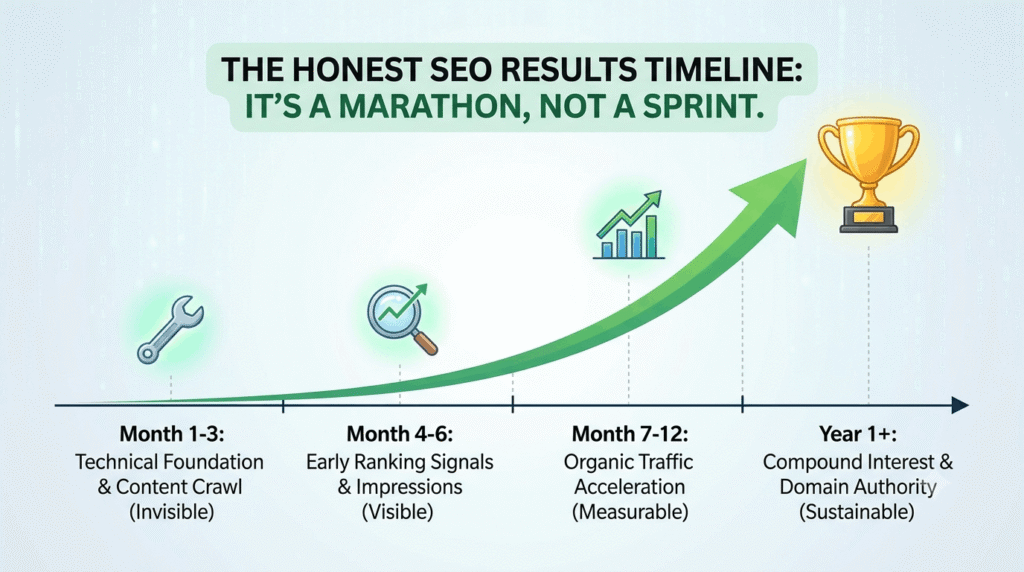
The honest answer is: SEO takes time. For many websites, noticeable improvements can begin appearing within 3 to 6 months, while stronger, more consistent results often take 6 to 12 months or longer. However, there is no universal timeline because SEO results depend on your website, industry, competition, content quality, technical health, backlinks, and the effectiveness of your strategy.
SEO is not an overnight marketing tactic. It is a long-term investment in building your website’s visibility, authority, and ability to attract qualified organic traffic.
In this guide, we’ll break down how long SEO really takes, what you can expect at each stage, the factors that influence SEO results, and how to improve your chances of seeing results faster.
The Honest Answer: How Long Does SEO Take?
For most websites, you can use the following timeline as a general benchmark:
- 0–3 months: SEO foundation and technical improvements
- 3–6 months: Early ranking and organic traffic improvements
- 6–12 months: More consistent rankings, traffic, and leads
- 12+ months: Stronger authority and sustainable organic growth
These are general estimates, not guarantees.
A brand-new website targeting highly competitive keywords may take significantly longer. On the other hand, an established website with strong authority and technical SEO may see improvements much sooner.
The key thing to understand is that SEO results usually happen gradually. You might first notice that a few pages start ranking for long-tail keywords. Then, as your content gains authority and your website improves, rankings can move higher and generate more clicks.
Over time, those small improvements can compound into significant organic growth.
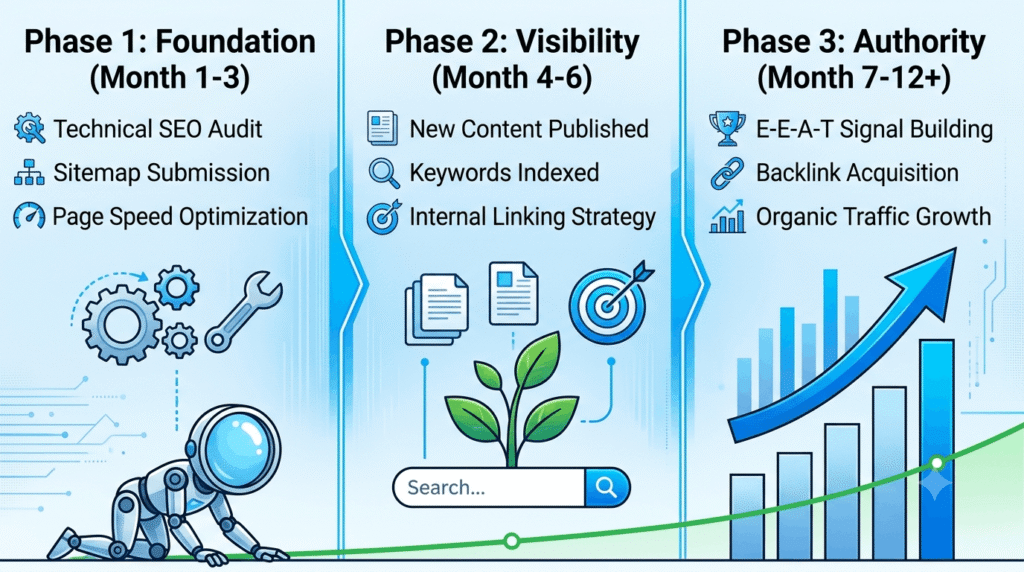
SEO Timeline: What to Expect
0–3 Months: The Foundation Phase
The first few months of SEO are usually focused on building the foundation.
During this stage, an SEO professional may work on:
- Technical SEO audits
- Website speed and performance
- Mobile-friendliness
- Keyword research
- Website structure
- URL optimization
- On-page SEO
- Meta titles and descriptions
- Internal linking
- Content strategy
- Google Search Console setup
- Sitemap and indexing issues
You may not see a dramatic increase in traffic during this phase, and that’s normal.
Think of it like preparing a house before building additional floors. If the foundation isn’t strong, adding more content or backlinks won’t deliver the best possible results.
What you might see:
- Pages getting indexed
- Initial keyword rankings
- Improvements for low-competition keywords
- Better technical health
- Increased impressions in search results
- Small increases in organic traffic
At this point, impressions can be an important early SEO indicator, even if clicks and conversions haven’t increased significantly yet.
3–6 Months: The Early Growth Phase
This is often when businesses start noticing that their SEO efforts are gaining momentum.
Your pages may begin ranking for more keywords, especially long-tail and lower-competition search terms.
You may start seeing:
- Increased organic impressions
- More keywords ranking in Google
- Improved positions for existing keywords
- Growing organic traffic
- More clicks from search results
- Initial leads or enquiries
However, don’t expect every target keyword to reach the first page within six months.
SEO is competitive. If you’re targeting keywords like “best digital marketing agency” or “real estate company in Mumbai,” you may need significantly more time and authority than you would for a highly specific long-tail keyword.
The goal during this stage is to build momentum rather than chase instant results.
6–12 Months: The Growth Phase
For many websites, the 6-to-12-month period is where SEO can become much more noticeable.
By this stage, your website may have:
- A larger library of optimized content
- More organic keywords ranking
- Stronger internal linking
- Better topical authority
- More quality backlinks
- Improved user experience
- Greater search engine trust
As your rankings improve, organic traffic can increase significantly.
This is also when you should start focusing less on traffic alone and more on business outcomes.
For example:
More traffic → More relevant visitors → More enquiries → More leads → More customers
A website receiving 10,000 monthly visitors isn’t necessarily successful if those visitors don’t match the business’s target audience.
The real value of SEO comes from attracting the right people, not simply attracting more people.
12+ Months: Long-Term SEO Success
SEO doesn’t stop once your website starts ranking.
In competitive industries, maintaining and improving rankings is an ongoing process.
After 12 months, successful SEO campaigns may benefit from:
- Stronger domain authority
- Higher rankings for competitive keywords
- Consistent organic traffic
- More qualified leads
- Better brand visibility
- Increased topical authority
- More opportunities to rank for new keywords
At this stage, your SEO strategy should evolve.
Instead of simply trying to rank for more keywords, you can focus on:
- Improving conversion rates
- Updating existing content
- Targeting higher-value keywords
- Building stronger backlinks
- Expanding into new content topics
- Improving user experience
- Optimizing pages that already generate traffic
The goal is to turn SEO from a marketing activity into a reliable customer acquisition channel.
What Factors Affect How Fast SEO Results Appear?
Not every website will experience SEO results at the same speed. Several factors can influence the timeline.
1. Website Age and Authority
A brand-new website generally has less authority than an established website with years of quality content and backlinks.
New websites often need time to build credibility and demonstrate relevance.
That doesn’t mean new websites can’t rank. It simply means they may need a more focused strategy, especially when competing against established brands.
2. Industry Competition
Competition is one of the biggest factors affecting SEO timelines.
For example, ranking for a local keyword such as:
“digital marketing agency in Kalyan“
may be easier than ranking for:
“digital marketing agency in India.”
The broader the keyword and the more valuable it is commercially, the more competition you may face.
Highly competitive industries such as finance, healthcare, real estate, and legal services can require more time and resources.
3. Keyword Difficulty
Not all keywords are equally difficult to rank for.
A long-tail keyword with clear search intent may be easier to rank for than a broad, high-volume keyword.
For example:
Broad keyword:
“SEO”
More specific keyword:
“SEO services for small businesses in Mumbai”
A smart SEO strategy doesn’t always focus on the keyword with the highest search volume.
Instead, it focuses on finding the right balance between:
- Search volume
- Competition
- Search intent
- Business relevance
- Conversion potential
4. Content Quality
Content is still an important part of SEO, but simply publishing hundreds of articles won’t guarantee results.
Your content should be:
- Helpful
- Original
- Well-researched
- Relevant to the target audience
- Easy to read
- Aligned with search intent
- Properly optimized
The best content answers the user’s question better than the alternatives available in search results.
Instead of asking, “How many blogs should I publish?”, ask:
“Can my content provide a genuinely better answer than what’s already ranking?”
That’s a much more useful SEO question.
5. Technical SEO
Technical problems can slow down SEO progress.
Issues such as:
- Poor website architecture
- Slow loading speed
- Mobile usability problems
- Broken links
- Duplicate content
- Indexing issues
- Incorrect canonical tags
- Poor internal linking
can make it harder for search engines to crawl, understand, and index your website effectively.
Before creating hundreds of new pages, it’s often worth making sure your technical foundation is healthy.
6. Backlinks and Website Authority
Quality backlinks can help strengthen your website’s authority.
However, the focus should be on quality and relevance, not simply collecting as many links as possible.
A few relevant, trustworthy links can be more valuable than a large number of low-quality or irrelevant links.
A sustainable SEO strategy focuses on earning authority naturally through:
- High-quality content
- Digital PR
- Industry partnerships
- Expert contributions
- Useful resources
- Genuine outreach
Avoid shortcuts that promise hundreds of backlinks overnight. They can create more problems than benefits.
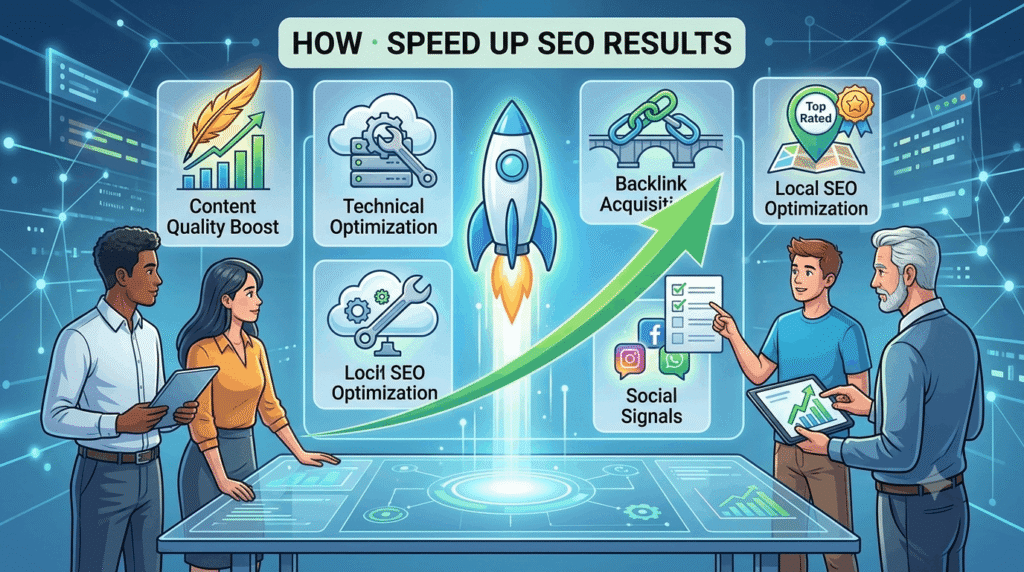
There is no magic button that guarantees faster rankings, but you can improve your chances by focusing on the right priorities.
1. Target Realistic Keywords
Don’t start by competing for the most difficult keyword in your industry.
Build momentum with relevant, achievable keywords and gradually move toward more competitive terms.
2. Fix Technical SEO Issues
Make sure search engines can properly crawl and index your important pages.
3. Create Helpful Content
Focus on answering real questions your target audience is searching for.
4. Improve Existing Content
Don’t only publish new blogs.
Review your existing pages and improve:
- Outdated information
- Search intent alignment
- Content depth
- Internal links
- Titles
- Headings
- Calls to action
Sometimes improving an existing page can be more effective than publishing another new article.
5. Build Relevant Authority
Earn backlinks and mentions from trustworthy websites within your industry or niche.
6. Strengthen Internal Linking
Connect related pages strategically to help users and search engines discover important content.
7. Track the Right Metrics
Don’t measure SEO success only by keyword rankings.
Track:
- Organic traffic
- Search impressions
- Click-through rate
- Keyword visibility
- Leads
- Enquiries
- Sales
- Conversion rate
The ultimate goal is not simply to rank.
The goal is to grow the business.
You may have seen businesses claim that they achieved SEO results in just a few weeks.
Is that possible?
Yes, sometimes.
But context matters.
A website that already has strong authority may see quick improvements after optimizing existing pages.
A local business with limited competition may also achieve visibility relatively quickly.
Similarly, targeting low-competition keywords can produce faster wins.
However, ranking a brand-new website for highly competitive keywords in a crowded industry is a completely different challenge.
This is why SEO timelines should always be based on the website’s current position and competitive environment, rather than a generic promise.
SEO vs Paid Advertising: What's the Difference?
One reason people become frustrated with SEO is that they compare it directly with paid advertising.
With paid advertising, you can potentially start receiving traffic as soon as your campaigns go live and your ads begin serving.
SEO works differently.
You invest time in:
- Creating content
- Improving your website
- Building authority
- Earning trust
- Optimizing for search intent
The benefit is that SEO can continue generating organic traffic without paying for every individual click.
In simple terms:
Paid Ads: Faster visibility, ongoing advertising spend.
SEO: Slower growth, but the potential for sustainable organic traffic over the long term.
The best marketing strategy for many businesses isn’t necessarily choosing one over the other. Depending on the business and goals, SEO and paid advertising can work together.
How Do You Know If Your SEO Is Working?
One of the biggest mistakes businesses make is waiting for a sudden jump in traffic.
SEO progress can be gradual.
Instead, look for smaller signals such as:
- Your website’s impressions are increasing
- More keywords are entering the top 100
- Existing keywords are moving upward
- More pages are being indexed
- Organic clicks are growing
- Users are spending more time on relevant pages
- Leads from organic search are increasing
For example, moving from position 80 to position 30 may not generate a huge amount of traffic immediately.
But it’s a positive signal.
If a keyword then moves from position 30 to position 10, the potential for clicks can increase significantly.
SEO is often about building momentum step by step.
The Biggest SEO Mistake: Expecting Instant Results
The biggest mistake businesses make is starting SEO for one or two months and then stopping because they don’t see immediate results.
SEO is a compounding process.
The content you publish today can continue attracting visitors months or even years later. A page that generates only a few visitors today may become a significant traffic source as it gains authority and rankings.
This is why consistency matters.
Instead of asking:
“Why am I not ranking after one month?”
Ask:
“Am I building the right foundation to rank six or twelve months from now?”
That mindset shift can make a huge difference.
Final Thoughts: So, How Long Does SEO Really Take?
Let’s give the honest answer one more time.
SEO can start showing early signs of progress within 3 to 6 months, while significant and sustainable results often take 6 to 12 months or longer.
But there is no guaranteed timeline.
Your results depend on:
- Your website’s current condition
- Industry competition
- Keyword difficulty
- Content quality
- Technical SEO
- Website authority
- Backlink profile
- SEO strategy
- Consistency
The good news is that SEO is not about achieving a temporary spike in traffic.
When done correctly, SEO can help build a long-term source of organic visibility, qualified traffic, leads, and business growth.
So, if you’re investing in SEO, don’t look for overnight success.
Build the foundation. Create genuinely helpful content. Improve your website. Earn authority. Track your progress. Stay consistent.
SEO is a marathon, not a sprint—and the businesses that stay committed often have the best opportunity to benefit from its long-term compounding value.