Google’s search algorithm never stands still. Every year, the search engine becomes better at understanding what people are looking for, identifying useful content, and filtering out pages that offer little real value.
In 2026, that evolution has continued at a rapid pace.
For website owners, SEO professionals, bloggers, and online businesses, the biggest challenge is no longer simply ranking for a keyword. Search is becoming more contextual, more personalized, and increasingly influenced by AI-powered experiences.
Google’s official Search Status Dashboard records several significant ranking-related changes in 2026 so far, including the February 2026 Discover update, March 2026 spam update, March 2026 core update, May 2026 core update, and June 2026 spam update.
At the same time, Google has published new guidance on optimizing for generative AI features in Search. The message is important for SEOs: traditional SEO fundamentals still matter, but websites need to focus more strongly on unique, valuable content and the needs of real users.
So, what exactly changed in 2026, and what should you do about it?
Let’s break it down.
What Changed in Google's Algorithm in 2026?
Rather than thinking of 2026 as one single “Google algorithm update,” it is more accurate to look at the year as a series of changes affecting different parts of Google’s search ecosystem.
The key areas to watch are:
- Core ranking systems
- Spam detection
- Google Discover
- AI-powered search experiences
- Content quality and originality
- User intent and relevance
- Website trust and topical expertise
Let’s explore each one.
1. Core Updates Continue to Reshape Search Rankings
Core updates are broad changes to Google’s ranking systems. They aren’t designed to target one specific website or one isolated SEO tactic. Instead, they can change how Google evaluates and ranks content across many topics.
In 2026, Google has already recorded March and May core updates. The May 2026 core update began on May 21 and completed its rollout on June 2.
The practical takeaway is simple:
A page that ranked well yesterday may not necessarily rank as well after a core update—and that doesn’t automatically mean the page has received a penalty.
Core updates can change the relative performance of competing pages.
For example, imagine you have an article ranking at position three for a competitive keyword. After a core update, your page falls to position eight. This could happen because Google has changed how it evaluates relevance, usefulness, depth, or overall quality—or because competing pages have become stronger.
How to Adapt
If your rankings drop after a core update, don’t immediately make random changes.
Instead:
- Compare your page with the pages now ranking above you.
- Check whether your content genuinely satisfies search intent.
- Improve outdated or incomplete information.
- Add original insights, examples, data, or first-hand experience.
- Remove unnecessary content that doesn’t help the reader.
- Strengthen internal linking between related pages.
- Review your website’s overall topical relevance.
The goal should not be to “beat the algorithm.”
The goal should be to make your website a better result for the person searching.
2. Google's Focus on Helpful, Original Content Is Becoming More Important
One of the clearest trends in modern SEO is Google’s continued emphasis on content that provides genuine value.
Publishing 100 articles that say essentially the same thing is unlikely to be a sustainable strategy.
The real opportunity lies in creating content that adds something new.
That could mean:
- Personal experience
- Original research
- Expert commentary
- Case studies
- Real examples
- Unique statistics
- Step-by-step processes
- First-hand testing
- Practical solutions
This is particularly important as AI makes it easier than ever to produce large quantities of generic content.
Google’s 2026 guidance for generative AI search specifically emphasizes the importance of valuable, unique, non-commodity content while also stating that established SEO best practices remain foundational.
How to Adapt
Before publishing an article, ask yourself:
“If someone removed the top 10 results from Google, would my article still offer something genuinely useful?”
If the answer is no, the content probably needs more originality.
Don’t simply rewrite what competitors have already published.
Instead, add your own perspective.
3. AI Is Changing How People Discover Information
Search behavior is changing.
Users increasingly expect search engines to understand complex questions, conversational queries, and multiple aspects of a topic.
Google’s own guidance in 2026 acknowledges the growth of generative AI experiences in Search and provides recommendations for websites seeking visibility within these new search experiences. Google also emphasizes that SEO fundamentals remain relevant to generative AI features.
This creates an important shift in SEO strategy.
You shouldn’t only ask:
“What keyword should I rank for?”
You should also ask:
“What question is the user really trying to answer?”
For example, someone searching:
may have a different intent from someone searching:
“Is digital marketing a good career in 2026?”
The first query may indicate commercial research.
The second may indicate career research.
Both contain different intents—and they deserve different content.
How to Adapt
Build content around topics and user journeys, not just individual keywords.
Create:
- Beginner guides
- Detailed tutorials
- Comparison articles
- FAQs
- Case studies
- Original research
- Expert opinions
- Supporting content
Use natural language and answer related questions within the same topic.
This helps create a more complete content experience for both users and search systems.
4. The February 2026 Discover Update Put More Emphasis on Original, Timely Content
Google’s February 2026 Discover core update was particularly interesting because it focused on the systems that surface content in Google Discover, rather than being a traditional web-search ranking update.
Google said the update aimed to:
- Show more locally relevant content
- Reduce sensational and clickbait content
- Surface more in-depth and original content
- Better identify websites with expertise in specific topics
Google also noted that expertise can be recognized on a topic-by-topic basis, meaning a website doesn’t necessarily need to cover only one subject to demonstrate expertise.
This matters because Discover traffic can be extremely valuable for publishers and content websites.
However, it also highlights a broader lesson for SEO:
Being useful isn’t enough. Your content also needs to be relevant, timely, original, and trustworthy.
How to Adapt for Google Discover
If Discover is important to your website:
- Create original articles with a clear point of view.
- Cover timely topics relevant to your audience.
- Avoid misleading headlines.
- Use high-quality images.
- Build expertise around specific subject areas.
- Keep your content fresh and accurate.
- Focus on topics your audience genuinely cares about.
Don’t write simply to generate clicks.
Write something worth clicking.
5. Spam Updates Are Making Manipulative SEO Riskier
Google also released spam-related updates in 2026, including the March 2026 spam update and June 2026 spam update. These updates are part of Google’s ongoing efforts to improve the quality of search results and address behavior that violates its spam policies.
This reinforces a long-standing SEO lesson:
Shortcuts can work temporarily, but they are not a reliable long-term strategy.
Websites that depend heavily on manipulative tactics, low-quality scaled content, or tactics designed primarily to exploit search systems can become increasingly vulnerable as Google’s systems improve.
How to Adapt
Build an SEO strategy around sustainable practices:
- Create useful content.
- Avoid keyword stuffing.
- Don’t publish large amounts of low-value content.
- Don’t manipulate links.
- Don’t create pages solely for search engines.
- Keep your website technically healthy.
- Focus on building genuine authority.
Think of SEO as an investment rather than a hack.
6. E-E-A-T Remains an Important Part of a Strong SEO Strategy
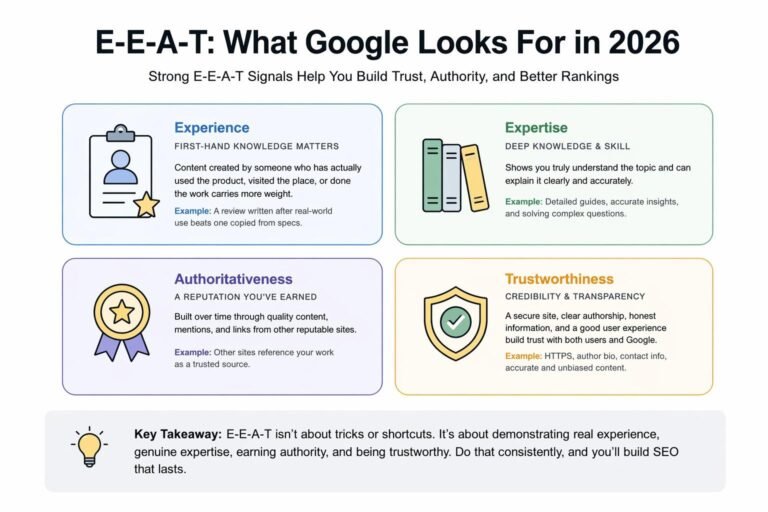
E-E-A-T stands for:
- Experience
- Expertise
- Authoritativeness
- Trustworthiness
Although E-E-A-T is not a single ranking factor that can simply be “optimized,” its principles are useful when evaluating content quality.
In 2026, demonstrating who is behind your content and why readers should trust that information is increasingly important—particularly for topics involving health, finance, legal matters, and other areas where inaccurate information can have serious consequences.
How to Strengthen E-E-A-T
Consider adding:
- Detailed author bios
- Relevant professional credentials
- First-hand experiences
- Original research
- Reliable citations
- Transparent business information
- Editorial policies
- Updated content
- Clear contact information
For example, if you’re writing about digital marketing, an article written by someone with practical experience running campaigns, analyzing SEO data, and working with real businesses can offer more credibility than generic content created purely to target keywords.
Your website should make it easy for users to understand:
Who wrote this?
Why should I trust this person?
Where did this information come from?
7. User Experience Still Matters
SEO isn’t only about content.
A visitor can land on your website and leave within seconds if the experience is frustrating.
Slow loading times, intrusive pop-ups, confusing navigation, poor mobile design, and difficult-to-read layouts can all hurt the overall quality of the user experience.
Your SEO strategy should therefore include:
- Mobile-friendly design
- Fast page loading
- Clear navigation
- Readable typography
- Logical content structure
- Helpful internal links
- Minimal intrusive elements
- Secure HTTPS implementation
Don’t optimize your website only for Google.
Optimize it for the people who use it.
How to Adapt Your SEO Strategy in 2026
If you want your website to remain competitive, focus on these seven areas.
1. Create Content That Deserves to Rank
Don’t ask:
“How many words should my article have?”
Ask:
“Does this article completely solve the reader’s problem?”
Word count is not the goal.
Value is.
2. Focus on Search Intent
Before creating content, understand what the searcher actually wants.
Analyze:
- The type of pages ranking
- Common questions
- User expectations
- Search intent
- Content gaps
- Related topics
Then create something that satisfies that intent better.
3. Add Original Insights
AI can summarize existing information.
Your advantage is adding something that isn’t easily copied.
Use:
- Personal experiences
- Client examples
- Case studies
- Screenshots
- Original data
- Expert interviews
- Unique opinions
This is one of the best ways to differentiate your content.
4. Use AI Responsibly
AI can be extremely useful for SEO.
You can use it to:
- Brainstorm topics
- Create outlines
- Find content gaps
- Improve readability
- Generate ideas
- Analyze large datasets
But don’t let AI replace human judgment.
The final content should be reviewed, fact-checked, edited, and improved by a human.
The question isn’t whether AI was involved.
The question is whether the final content is actually useful.
5. Build Topical Authority
Instead of publishing random articles across dozens of industries, create meaningful topic clusters.
For example, a digital marketing website could build a cluster around SEO:
Main Topic: SEO Guide
Supporting content:
- Keyword Research
- On-Page SEO
- Technical SEO
- Link Building
- Local SEO
- SEO Audit
- Google Search Console
- SEO Content Writing
Connect these pages with relevant internal links.
This creates a clearer information architecture and helps users navigate your website.
6. Monitor Your SEO Performance
Don’t wait for a major algorithm update to check your website.
Track your performance regularly using tools such as:
- Google Search Console
- Google Analytics
- Rank tracking software
- Page-speed tools
- Technical SEO crawlers
Monitor:
- Organic traffic
- Rankings
- Impressions
- Click-through rate
- Indexing
- Top-performing pages
- Pages losing traffic
If traffic suddenly drops, compare the timing with Google’s official Search Status Dashboard before assuming that an algorithm update is responsible.
7. Don’t Panic After Every Algorithm Update
This is one of the most important pieces of advice.
SEO professionals often make the mistake of changing everything immediately after a ranking fluctuation.
That’s rarely a good idea.
First, determine:
- Did Google announce an update?
- Is the update complete?
- Which pages were affected?
- Did competitors experience similar changes?
- Is the issue technical or content-related?
- Has search intent changed?
- Have stronger competitors entered the results?
Then make informed decisions.
SEO is a long-term game.
A Practical 2026 SEO Checklist
Use this checklist to evaluate your website:
Content
- Does every important page satisfy a clear search intent?
- Is the content original and genuinely useful?
- Does it provide insights beyond competing pages?
- Is outdated information regularly refreshed?
- Are facts and statistics properly verified?
Trust & Expertise
- Are authors clearly identified?
- Are credentials or relevant experience visible?
- Are trustworthy sources cited?
- Does the website clearly explain who operates it?
Technical SEO
- Is the website mobile-friendly?
- Are important pages indexable?
- Is the site easy to crawl?
- Are Core Web Vitals monitored?
- Are broken links and technical errors fixed?
User Experience
- Is navigation simple?
- Are pages easy to read?
- Are intrusive pop-ups limited?
- Can users quickly find the information they need?
AI Search Readiness
- Does your content provide unique value?
- Are important questions answered clearly?
- Is your website’s expertise obvious?
- Does your content cover topics comprehensively?
- Are you creating content for people rather than search engines?
Final Thoughts
Google’s algorithm updates in 2026 are a reminder that SEO is becoming less about gaming rankings and more about building genuinely valuable websites.
The direction is clear.
Create useful content.
Understand your audience.
Demonstrate experience and expertise.
Build trust.
Improve your website experience.
And use AI as a tool—not as a substitute for knowledge, research, and human judgment.
The websites most likely to succeed in the long term won’t necessarily be the ones publishing the most content. They will be the ones that consistently give people a reason to choose their content over everything else available.
The future of SEO isn’t about chasing every algorithm update. It’s about building a website that remains valuable regardless of the update