In the early days of digital marketing, the blast-and-pray approach—sending a single, identical email to your entire subscriber list—was considered standard practice. It was straightforward, required minimal effort, and seemed to check the box for “email marketing.”
Today, that approach is not only outdated; it is actively damaging your business.
Consumers are flooded with digital noise. Every day, inboxes are inundated with promotional offers, newsletters, transactional notifications, and alerts. In this hyper-competitive landscape, generic messaging gets ignored, deleted, or, worse, marked as spam. If you are still treating your email list as a monolith, you are burning your budget, eroding trust, and missing out on significant revenue.
The solution lies in email segmentation. By dividing your audience into smaller, targeted groups based on specific criteria, you can deliver relevant, personalized content that resonates. Here is why sending the same email to everyone is a critical mistake and how segmentation can transform your marketing strategy.
1. The Death of the "Average" Customer
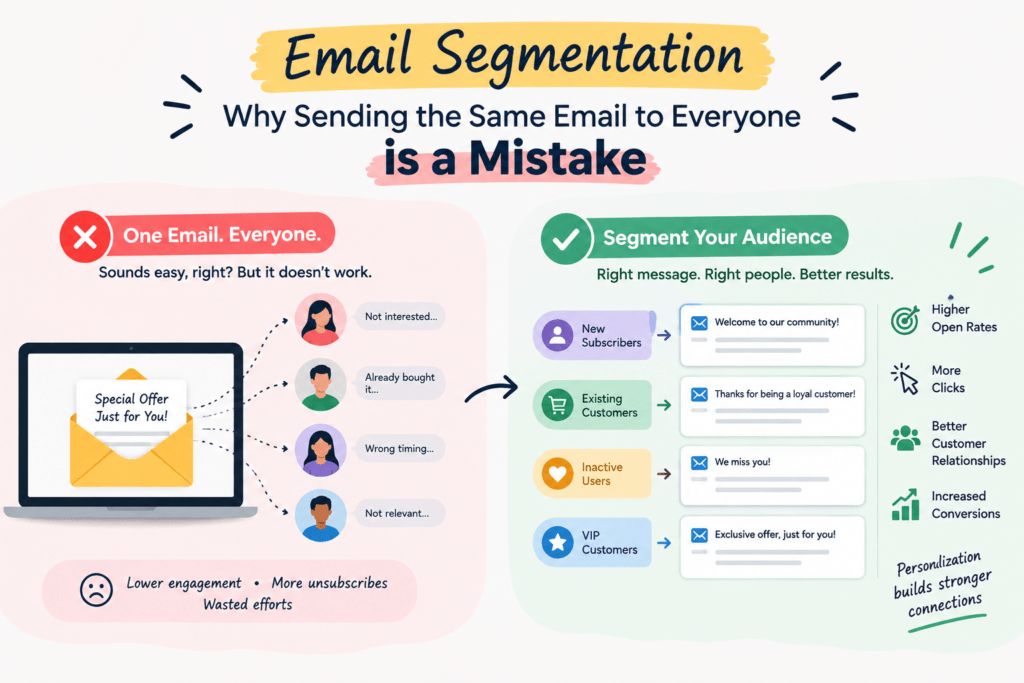
The fundamental flaw of mass emailing is the assumption that your audience is uniform. Unless your business sells one hyper-niche product to a completely homogeneous group of people, your subscribers have vastly different needs, budgets, pain points, and behaviors.
Consider an e-commerce apparel brand. On your mailing list, you likely have:
Brand-new subscribers who just signed up for a 10% discount.
Loyal, repeat buyers who purchase every month.
Shoppers who exclusively buy menswear.
Bargain hunters who only purchase during clearance sales.
If you send a generic promotional email showcasing a new high-end women’s winter coat to this entire list, what happens?
The loyal male shopper is annoyed by irrelevant content.
The bargain hunter ignores it because it’s not on sale.
The brand-new subscriber might not even know what your brand stands for yet.
When you try to speak to everyone, you end up speaking to no one. Generic messaging lacks the specificity required to capture attention. Segmentation allows you to acknowledge that your customers are individuals with distinct preferences.
2. The Toll on Key Metrics: Open Rates, Click Rates, and Conversions
When relevance drops, performance metrics follow suit. Continuing to send unsegmented campaigns triggers a downward spiral across all key performance indicators (KPIs):
Low Open Rates
Subject lines that try to appeal to the “general public” are inherently vague or weak. A subscriber scrolling through dozens of morning emails will quickly bypass a subject line that bears no relation to their immediate interests or current stage in the customer journey.
Plummeting Click-Through Rates (CTRs)
Even if a subscriber opens your email, a generic call-to-action (CTA) or mismatched product recommendation will fail to inspire action. If they clicked expecting one thing and found another, they bounce immediately.
Rising Unsubscribe and Spam Complaint Rates
This is the ultimate penalty for laziness in email marketing. When people consistently receive emails that add zero value to their lives, they do not just ignore them—they opt out. High unsubscribe rates hurt your sender reputation, which eventually lands your future emails in the dreaded spam folder, harming deliverability even for your engaged subscribers.
3. The Power of Relevance: Why Segmentation Works
Human psychology is wired for personalization. We pay attention to things that directly affect us, solve our problems, or cater to our specific tastes. Email segmentation leverages this psychological trigger by ensuring message-to-market alignment.
According to numerous industry studies, segmented campaigns consistently outperform non-segmented blasts across the board. Marketers who use segmentation frequently report:
Higher open rates because the subject lines speak directly to a niche group’s desires or recent behaviors.
Increased revenue because product recommendations are tailored to past purchase history or browsing habits.
Better customer retention because communication feels like a 1-on-1 conversation rather than a corporate megaphone.
When you send a mother shopping for toddler clothes an email featuring a newly launched toddler line—rather than a generic baby-clothing blast—you reduce friction in the buying process. You make it easy for them to say “yes.”
4. How to Start Segmenting Your Email List
If you have been relying on a single subscriber list, transitioning to a segmented strategy can feel overwhelming. Fortunately, you don’t need to overcomplicate it. Start with these foundational segmentation pillars:
A. Demographic Segmentation
This is the lowest-hanging fruit. Divide your audience based on basic data points such as age, gender, geographic location, or job title (for B2B). For example, a local service provider can send region-specific promotions, or a clothing brand can tailor styles by gender.
B. Behavioral Segmentation (The Gold Standard)
Actions speak louder than demographic data. Behavioral segmentation looks at what your subscribers actually do:
Purchase History: Don’t cross-sell a product someone bought yesterday. Instead, recommend complementary accessories or replenishment items.
Website Activity: If a user spends time browsing a specific category on your site without buying, trigger an email highlighting bestsellers or educational content related to that category.
Email Engagement: Separate your super-engaged openers from cold subscribers. Reward your loyalists with exclusive perks while running a re-engagement campaign for the inactive segment.
This is the lowest-hanging fruit. Divide your audience based on basic data points such as age, gender, geographic location, or job title (for B2B). For example, a local service provider can send region-specific promotions, or a clothing brand can tailor styles by gender.
C. Lifecycle Stage / Customer Journey Segmentation
A first-time visitor is in a very different mindset than a five-year brand advocate. Map your emails to where they are in the funnel:
Welcome Series: For new leads getting to know your brand.
Abandoned Cart / Browse Abandonment: For warm prospects who got distracted.
Post-Purchase Follow-ups: For buyers needing onboarding, setup guides, or review requests.
VIP / Loyalty Campaigns: For your top 10% spenders who deserve white-glove treatment.
5. Overcoming Common Objections to Segmentation
Marketers often resist segmentation for a few common reasons. Let’s debunk them:
“It takes too much time.” Modern Email Service Providers (ESPs) make segmentation automated and seamless. Once you set up your tags, dynamic content blocks, and automated workflows, the system does the heavy lifting for you.
“My list is too small.” Even a small list benefits from segmentation. If you have 500 subscribers, splitting them into groups allows you to build deeper, more meaningful relationships early on. Scaling segmentation later is much easier if the habit is baked into your culture from day one.
“I don’t have enough data.” You don’t need a massive data footprint to start. Use preference centers during signup, ask simple questions in welcome emails, and track basic behaviors like what links they click.
Conclusion
Email marketing remains one of the highest-ROI channels available to businesses, but its effectiveness depends entirely on the quality of the connection you build with your subscribers.
Treating your email list like a stadium full of strangers where you shout a single, generic message is a recipe for low engagement and high churn. By shifting toward a segmented strategy, you respect your subscribers’ time, honor their preferences, and turn your email channel into a precision-targeted revenue engine.
Stop talking to everyone. Start talking to someone—the right someone, with the right message, at the exact right time.