Fast forward to today, and the landscape looks entirely different. Artificial intelligence isn’t just writing subject lines anymore—it’s analyzing real-time behavior, predicting customer churn, orchestrating multi-channel workflows, and building entire automated campaigns from a single text prompt.
If you are looking to upgrade your tech stack, choosing the right platform can feel overwhelming. Let’s break down the best AI email marketing tools on the market and figure out which one fits your business model.
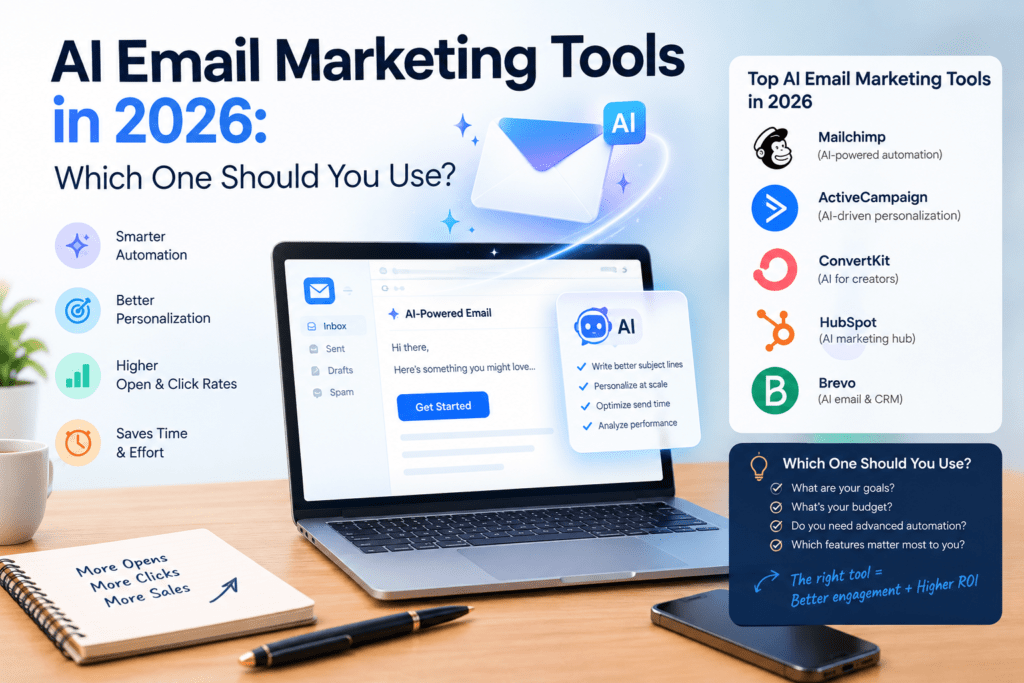
The Top Contenders at a Glance
| Tool | Best For | Standout AI Feature | Pricing Starts At |
| ActiveCampaign | Advanced behavioral automation | AI Autonomous Agents & Predictive Send-Time | $29/mo |
| Klaviyo | E-commerce & D2C retention | Predictive lifetime value & churn analytics | Free / Usage-based |
| HubSpot | CRM-integrated B2B marketing | CRM-native Breeze AI Email Writer | Free / $20/mo |
| Omnisend | E-commerce omnichannel (Email + SMS) | Natural-language segmentation & prompt-to-workflow | Free / $16/mo |
| Brevo | Budget-friendly SMBs | Perfect Timing send-time optimization | Free / $25/mo |
Deep Dive: Choosing the Right Tool for Your Goal
1. ActiveCampaign: Best for Complex Automation & Scaling
If your strategy relies heavily on intricate logic trees, multi-channel pathways (email, SMS, site messaging), and deep CRM data, ActiveCampaign remains a powerhouse.
The AI Advantage: Its machine learning engine doesn’t just predict the best time to send an email to an individual user; its autonomous agents help build, execute, and analyze campaign paths with minimal human friction.
Who it’s for: Growing small-to-medium businesses and marketing teams that view email as part of a larger, dynamic customer journey.
2. Klaviyo: The Undisputed King of E-commerce
For online stores running on Shopify or WooCommerce, Klaviyo leverages first-party shopping data better than almost anyone else.
The AI Advantage: Klaviyo’s predictive analytics engine can accurately forecast a customer’s next order date, likelihood of churn, and expected customer lifetime value (LTV). You can automatically target customers who are “slipping away” before they even realize they’re losing interest.
Who it’s for: Direct-to-consumer (DTC) and e-commerce brands where product recommendations and buying behavior drive revenue.
3. HubSpot: Best for B2B and CRM-First Strategies
If your sales and marketing teams live inside a CRM, pulling email copy from an isolated tool creates unnecessary friction. HubSpot solves this seamlessly.
The AI Advantage: Powered by its native AI suite (including the Breeze Copilot/Email Writer), HubSpot drafts copy, builds variations, and personalizes messages using deep contextual data from your actual CRM lifecycle stages—not generic templates.
Who it’s for: B2B companies, tech startups, and service providers already utilizing (or willing to utilize) HubSpot’s ecosystem.
4. Omnisend: Best for E-commerce Marketers Wanting Speed
If you want an e-commerce platform that gets straight to the point without a massive learning curve, Omnisend shines.
The AI Advantage: Omnisend features robust natural-language segmentation that lets you type prompts like “Show me buyers who haven’t purchased in 60 days” to instantly build segments, alongside automated workflow generation.
Who it’s for: E-commerce shops looking for a streamlined, multi-channel setup (combining email and SMS) that takes minutes rather than days to master.
How to Choose: 3 Questions to Ask Yourself
Before locking into a yearly subscription, evaluate your stack against these three criteria:
What are you actually selling? If it’s physical products through an e-commerce platform, lean toward Klaviyo or Omnisend. If it’s software, services, or B2B pipelines, look closely at ActiveCampaign or HubSpot.
Does the AI learn from your account data? Beware of generic AI wrapper tools that just plug into OpenAI to write basic emails. The best tools leverage your historical open rates, buyer behaviors, and CRM properties to make intelligent predictions.
What does your pricing curve look like? Many platforms look affordable at 500 contacts, but scale steeply once you cross 10,000 or 50,000 subscribers. Always map your projected growth against the platform’s pricing tiers.
Final Verdict
There is no single “best” tool—only the tool that matches your business model. If you run an online store, start with Klaviyo. If you manage complex lead nurturing and automation flows, choose ActiveCampaign. If you want a unified CRM and marketing engine, stick with HubSpot.
Which AI email feature do you rely on the most—automated copywriting, predictive send times, or behavioral segmentation?