AI is no longer just about generating a quick blog post or drafting social media captions; it spans predictive analytics, agentic automations, hyper-personalized campaigns, and search visibility optimization (GEO).
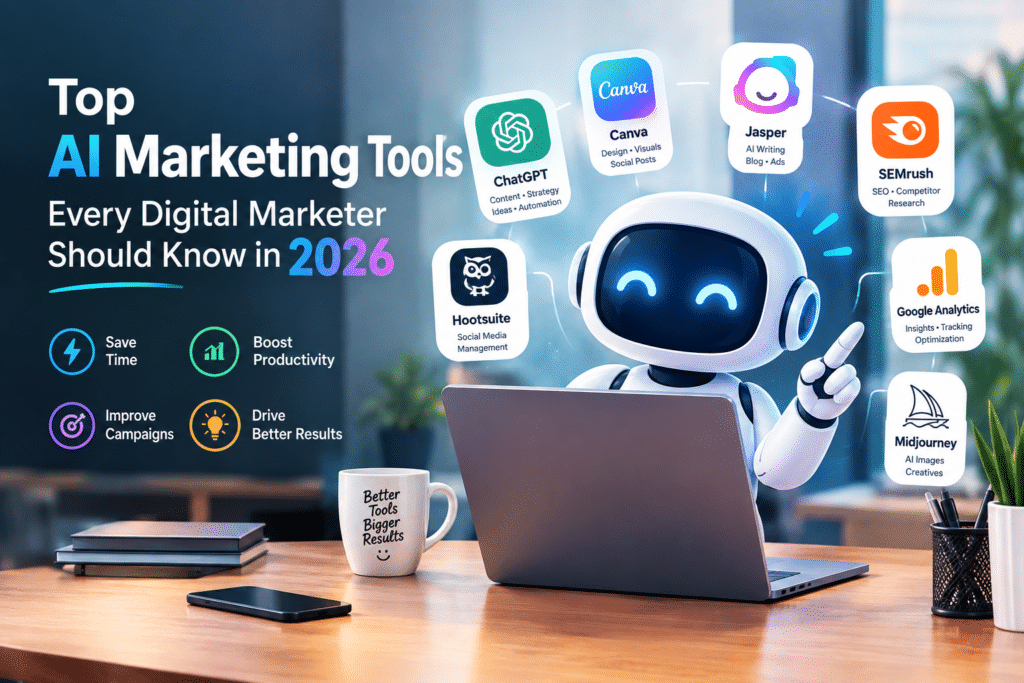
In 2026, artificial intelligence has evolved from a basic assistant into the operational backbone of modern digital marketing, empowering professionals to scale campaigns with unprecedented speed and precision. Content creation and search visibility are now streamlined by advanced platforms like Jasper AI and Surfer SEO, which help marketers tailor content to modern search intent and deep brand voices. Meanwhile, the rise of agentic workflow automations through tools like Gumloop frees teams from manual data tasks by executing complex, multi-step marketing sequences autonomously. Combined with creative powerhouses like Canva AI and native ad platforms like Meta Advantage+ and Google Performance Max that dynamically optimize paid media, today’s marketers can leverage these technologies to handle mechanical execution while focusing their energy on high-level strategy and authentic customer connection.
1. Content Creation & Copywriting: Jasper AI & ChatGPT
Content velocity is higher than ever, and generative AI is the engine keeping up with the demand.
What they do: Help marketers draft blog outlines, long-form articles, high-converting ad copy variations, and email sequences in minutes.
Why they matter in 2026: Tools like Jasper AI have evolved past generic text generation to deeply analyze brand voices, guidelines, and target audience psychographics. Meanwhile, advanced large language models act as all-purpose brainstorming and research partners.
Pro Tip: Use AI to build the first draft and structure (reducing production time by 50-70%), but always apply human oversight to add genuine insights and ensure brand alignment.
2. SEO & Search Optimization: Surfer SEO & Semrush AI
With search engine results pages (SERPs) heavily shaped by AI summaries and changing algorithms, traditional SEO strategies require an upgrade.
What they do: Automate keyword research, generate content briefs, perform technical audits, and analyze what’s missing from your pages compared to top-ranking competitors.
Why they matter in 2026: Surfer SEO and Semrush’s AI features help marketers optimize content not just for keywords, but for modern search intent and Generative Engine Optimization (GEO). They pinpoint exact topical gaps to ensure your content stands out.
3. Workflow & Agentic Automation: Gumloop & Zapier
The biggest shift in 2026 marketing technology is the rise of agentic AI—systems that don’t just suggest actions, but execute multi-step workflows autonomously.
What they do: Connect your disparate marketing apps and run complex, automated chains of tasks without manual intervention.
Why they matter in 2026: Platforms like Gumloop allow marketers to build visual AI agents that handle data scraping, lead enrichment, report generation, and content cross-posting. Instead of spending hours moving data between your CRM and social tools, agentic workflows handle the busywork in the background.
4. Social Media Management & Design: Sprout Social & Canva AI
Managing multiple social channels and producing eye-catching graphics used to require a massive team or specialized design skills.
What they do: Streamline social scheduling, listening, and graphic asset creation.
Why they matter in 2026:
Sprout Social integrates AI Assist to generate engaging captions, analyze sentiment data, and offer actionable insights from social listening.
Canva AI allows marketers with zero graphic design background to generate brand-consistent social posts, ad creatives, and short videos simply through text prompts and smart layout suggestions.
5. Paid Advertising & Campaign Optimization: Google Performance Max & Meta Advantage+
Paid media platforms have fully embraced native AI optimization to maximize return on ad spend (ROAS).
What they do: Automatically manage real-time bidding, audience targeting, and creative testing across channels.
Why they matter in 2026: Rather than manually adjusting bids or splitting ad groups, marketers feed creative assets and budget parameters into Google Performance Max or Meta Advantage+. The underlying AI tests hundreds of variations, shifting budget dynamically toward the highest-performing segments in real time.
Final Thoughts: The Human Advantage
The marketing landscape in 2026 rewards marketers who embrace AI, not those who try to outrun it. While AI handles data analysis, content drafting, and repetitive automations, the ultimate differentiator remains human strategy, creativity, and empathy.
By letting AI manage the mechanical execution, you free up the mental bandwidth to focus on what truly matters: big-picture storytelling and authentic customer connections.
What is your favorite AI marketing tool of 2026, and how has it changed your daily workflow? Let us know in the comments below!