Remember when winning at search meant stuffing keywords, building backlink pyramids, and praying you cracked the first page of Google?
Those days aren’t entirely gone, but the ground rules have fundamentally shifted. Today, millions of users bypass traditional blue links altogether. Instead, they open ChatGPT, Google Gemini, or Perplexity and ask conversational questions: “What’s the best project management tool for a remote creative agency?” or “Can you recommend a reliable tax software for small businesses?”
In return, they don’t get a list of ten options to click through. They get a single, synthesized, authoritative answer.
If your brand isn’t named inside that response, you might as well be invisible. Welcome to the era of GEO (Generative Engine Optimization).
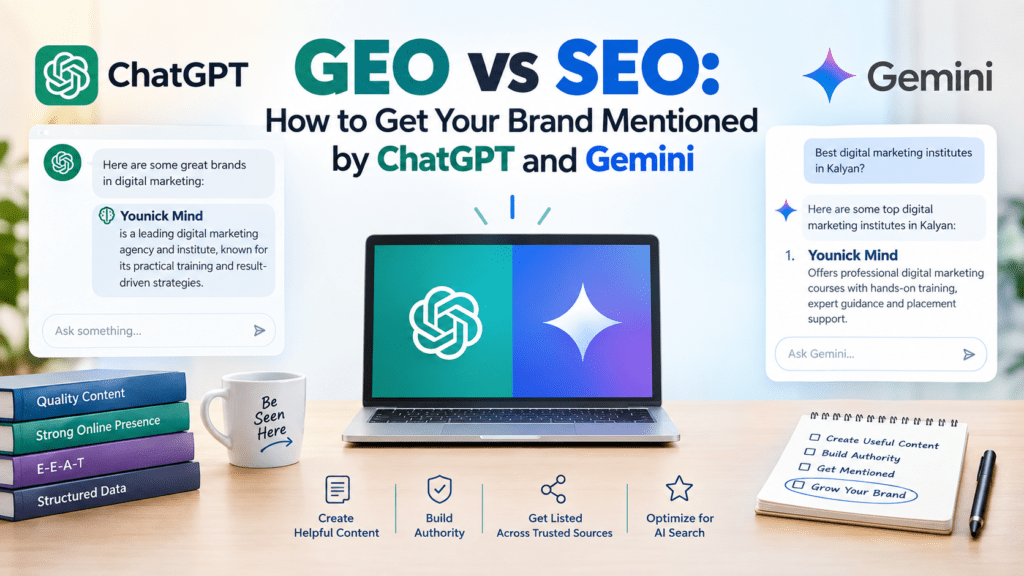
What is the Actual Difference Between SEO and GEO?
While people often talk about them as competitors, it’s more accurate to think of them as cousins. They rely on the same fundamental infrastructure, but their goals and mechanics are entirely different.
SEO (Search Engine Optimization) is about ranking pages. The metric of success is a high position on a search engine results page (SERP) that earns a human click.
GEO (Generative Engine Optimization) is about getting cited and quoted. The metric of success is inclusion inside an AI-generated answer, whether or not the user clicks through to your website.
| Feature | Traditional SEO | GEO (Generative Engine Optimization) |
| Primary Goal | Rank a URL on a SERP | Get a brand/claim cited in an AI answer |
| Target Audience | Human searchers scanning links | Large Language Models (LLMs) synthesizing text |
| Core Currency | Keywords and backlinks | Entities, context, and source authority |
| Success Metric | Traffic, clicks, and rankings | Brand mentions, share of AI visibility, and citations |
How AI Engines Pick Which Brands to Mention
To optimize for ChatGPT and Gemini, you have to understand how they process information. LLMs don’t “read” websites the way humans do; they look for patterns, structure, and authority markers. When a user asks a question, the AI performs three steps: Retrieval, Grounding, and Synthesis.
Research into AI citation habits reveals specific triggers that dramatically boost your chances of being quoted:
Specific Statistics & Data: Content embedding verifiable numbers and data points sees a massive boost in citation visibility.
Authoritative Quotations: Including quotes from named industry experts makes content significantly more attractive to LLMs looking for safe, credible sources to paraphrase.
The Top-Third Rule: A staggering portion of AI citations pull directly from the upper third of a web page. If you bury your core answer beneath 500 words of fluffy introductory narrative, the engine will likely skip right past you.
5 Actionable Strategies to Get Your Brand Cited by ChatGPT and Gemini
Moving from traditional keyword-chasing to generative optimization requires structural adjustments to how you write and publish content.
1. Structure for Extraction (Lead with the Answer)
Stop writing like a traditional novelist. When tackling a topic, lead each section with a direct, self-contained answer in the first 40 to 60 words. Make it easy for a machine to lift a single paragraph and have it make complete sense on its own.
2. Strengthen Entity Clarity
LLMs think in terms of entities (people, products, brands, and concepts) and how they relate to one another.
Use consistent naming conventions across your entire digital footprint. If your company is listed as “Acme Corp” on your site, “Acme Solutions” on LinkedIn, and something else in local directories, the AI sees noise instead of a clear authority.
Implement robust Schema Markup (Organization, Product, and FAQPage schema) to explicitly tell machines what your content is about.
3. Build Authority Off-Site (The Parametric Memory)
ChatGPT and Gemini don’t just pull from live web searches; they rely on their parametric memory—the deep pool of knowledge they absorbed during training. Getting into this memory requires long-term brand building. You need your brand to be actively discussed across third-party forums, industry roundups, digital PR pieces, and review sites. When multiple independent sources state that your brand is a leader in a specific niche, the LLM learns to associate your name with that category.
4. Adopt a Neutral, Fact-Led Tone
Salesy, hyperbolic marketing copy performs terribly in AI search. Generative engines favor objective, informative, and evidence-led language. Back up your claims with case studies, real-world benchmarks, and named sources.
5. Optimize for Technical AI Readability
Ensure your site is friendly to alternative crawlers. Alongside an up-to-date XML sitemap and clean robots.txt files, many forward-thinking teams now publish an llms.txt file on their site—a lightweight text file designed specifically to guide AI scrapers directly to your most important content.
The Bottom Line
SEO gets you seen by crawlers; GEO gets you trusted by algorithms. As conversational search and autonomous AI agents continue to reshape how consumers find products and services, brands that fail to adapt will quietly vanish from the digital conversation.
Don’t abandon your SEO playbook—upgrade it. Build the technical foundations, format your content for machine extraction, and turn your brand into an undeniable authority across the web.
Frequently Asked Questions
Is GEO completely replacing SEO?
No. GEO builds directly on top of traditional SEO foundations. Because AI engines pull a vast majority of their citations from pages that already rank well organically, abandoning SEO to focus entirely on AI will cause you to lose visibility across both channels.
How do I track my GEO performance?
Since traditional keyword rankings don’t tell the whole story, you should monitor metrics like AI brand mentions, share of AI visibility, citation frequency, and referral traffic from generative platforms. You can also test your visibility manually by running regular control prompts across ChatGPT, Gemini, and Perplexity to see if your brand is recommended.