Performance Max (PMax) campaigns are Google’s goal-based, AI-driven campaign type designed to serve ads across all of Google’s primary inventory—including Search, Shopping, YouTube, Display, Discover, Gmail, and Maps—from a single setup. By supplying creative assets, budgets, and target goals, advertisers allow Google’s machine learning algorithms to automatically handle real-time bidding, dynamic creative assembly, and cross-channel placement.
What Is Performance Max?
Performance Max is an all-in-one, goal-based campaign type that leverages machine learning to serve ads across Google’s full suite of properties. Instead of manually configuring separate Search, Display, and Video campaigns, advertisers supply creative assets, landing pages, conversion tracking, and audience signals. Google’s algorithms handle real-time bidding, targeting, and layout generation to drive specified conversion goals.
Key Updates: What Changed for PMax in 2026?
Early versions of PMax faced heavy criticism for lack of transparency and brand cannibalization. Google has addressed many of these pain points through major feature rollouts:
Granular Reporting Controls: Channel-level performance reports and search term insights show exact spend allocation across Search, Shopping, YouTube, and Display.
Brand & Keyword Exclusions: Account-level and campaign-level negative keywords prevent PMax from taking credit for low-hanging branded searches.
AI Overviews Integration: Ads now serve directly within Google’s AI Overviews and AI Mode search features.
High Value Mode: Advanced bidding rules let brands bid aggressively for new, high-lifetime-value customers over returning buyers.
Demographic Controls & Exclusions: Advertisers can refine campaigns using age, gender, and regional exclusions previously absent in PMax.
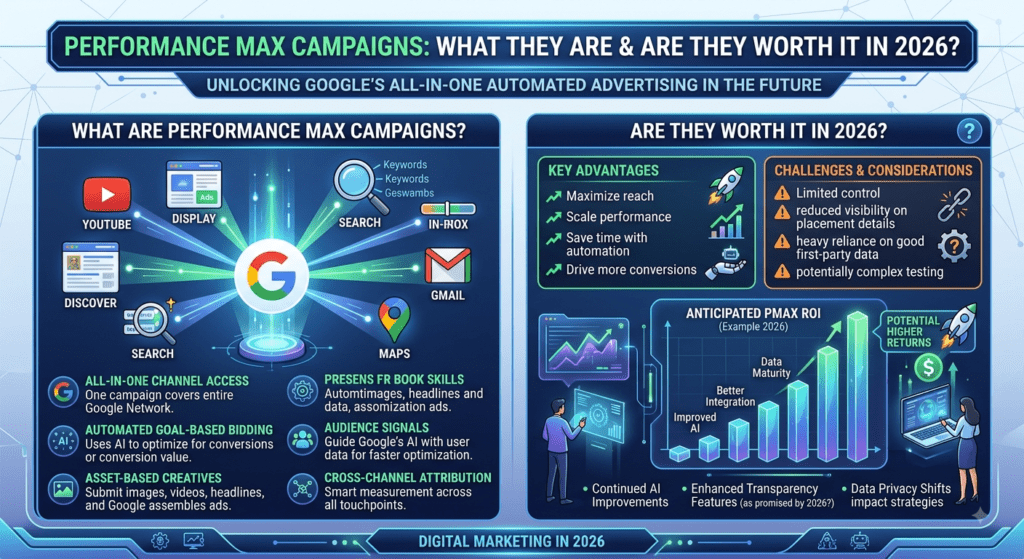
Pros vs. Cons in 2026
| Feature | Strengths (Pros) | Potential Drawbacks (Cons) |
| Reach & Scale | Single setup spans Search, YouTube, Maps, Gmail, and Display. | Can spend budget on low-intent Display or app placements if unmonitored. |
| Automation | Real-time bidding adapts to user signals across intent stages. | Demands accurate, high-volume conversion data to learn effectively. |
| Creative Assembly | Automatically builds ad variations across all ad formats. | Auto-generated videos and assets can lack brand polish if not custom-supplied. |
| Control | Campaign-level negative keywords and brand exclusions. | Still provides less granular control than pure manual Search campaigns. |
E-Commerce vs. Lead Generation: Which Works Better?
PMax performance varies significantly based on business model:
E-Commerce
PMax remains a standout performer for e-commerce. Fueled by Google Merchant Center product feeds, PMax acts as a high-intent Shopping engine enhanced by dynamic video and display remarketing. E-commerce accounts frequently achieve high Return on Ad Spend (ROAS) when product data is optimized.
Lead Generation
Lead gen requires tighter guardrails. Left unmonitored, PMax algorithms often pursue cheap form-fills that result in spam or low-intent leads. Success in lead gen requires Offline Conversion Tracking (OCT) or Value-Based Bidding (VBB) to feed real deal-stage data back to the AI.
The Verdict: Are PMax Campaigns Worth It in 2026?
Yes—provided you treat PMax as an engine that requires strict governance, not a set-it-and-forget-it campaign.
PMax is no longer the “black box” it once was. The addition of channel reports, demographic controls, and brand exclusion lists makes it a core pillar of modern digital marketing strategies.
Best Practices to Win with PMax in 2026
Set Brand Exclusions: Exclude brand name search terms so PMax focuses on net-new acquisition rather than capturing existing intent.
Supply High-Quality Video & Images: Upload custom 16:9, 1:1, and 9:16 assets to keep Google from generating low-quality auto-videos.
Implement Value-Based Bidding: Track offline conversions or CRM deal values so the algorithm optimizes toward revenue rather than sheer conversion volume.
Use PMax Alongside Standard Search: Maintain dedicated Search campaigns for high-priority exact-match keywords while using PMax for broad cross-channel expansion.
Conclusion:
In 2026, Performance Max is definitively worth the investment, particularly for e-commerce brands and businesses with rich conversion data. Recent feature additions—such as detailed channel-level reporting, account-level negative keywords, and robust brand exclusion controls—have successfully addressed PMax’s historical “black box” reputation, giving marketers necessary transparency while retaining the scale of automation. So long as it is backed by accurate conversion tracking, strict negative keyword guardrails, and high-quality creative assets, PMax remains a high-performing cornerstone of modern Google Ads strategies.