If you’ve ever launched an online advertisement and wondered why people aren’t clicking on it, you’re not alone. Many businesses spend money on advertising platforms such as Google Ads, Facebook Ads, Instagram Ads, and YouTube Ads, only to discover that impressions don’t always lead to conversions.
In many cases, the problem isn’t the product, the service, or even the budget. The real issue is the ad copy.
Great ad copy grabs attention, creates interest, builds trust, and encourages people to take action. In today’s highly competitive digital world, a few carefully chosen words can be the difference between an ad that generates revenue and one that simply disappears into the background.
In this guide, you’ll learn exactly how to write high-converting ad copy that attracts clicks and helps grow your business.
Ad copy is the text used in advertisements to persuade people to take a specific action. This action could include:
- Clicking a link
- Purchasing a product
- Filling out a contact form
- Booking an appointment
- Downloading an application
- Subscribing to a newsletter
Whether you’re running Google Search Ads, Facebook campaigns, Instagram promotions, or YouTube advertisements, your message plays a critical role in determining the success of your campaign.
Thousands of advertisements compete for people’s attention every single day. Most of them are ignored because they fail to communicate value quickly.
Effective ad copy helps you:
- Increase click-through rates (CTR)
- Improve conversion rates
- Lower advertising costs
- Build credibility and trust
- Generate more leads and sales
Simply put, stronger copy usually produces better results.
Step 1: Understand Your Target Audience
Before writing a single word, identify exactly who you’re speaking to.
Ask yourself the following questions:
- What problems are they facing?
- What goals do they want to achieve?
- What are their biggest concerns?
- What solution are they looking for?
Imagine that you own a digital marketing agency. Instead of saying:
“We provide digital marketing services.”
You could say:
“Get more qualified leads and increase your sales with data-driven marketing strategies.”
The second example focuses on the customer’s needs rather than the business itself.
Step 2: Write Headlines That Capture Attention
The headline is the first thing people notice. If it fails to grab attention, the rest of your advertisement may never be read.
Strong headlines often include:
- Numbers
- Questions
- Emotional triggers
- Urgency
- Clear benefits
Examples
❌ Grow Your Business
✅ Increase Your Sales by 40% in 90 Days
❌ Digital Marketing Services
✅ Generate More Leads Without Increasing Your Budget
Step 3: Focus on Benefits Instead of Features
Many businesses make the mistake of listing features while ignoring benefits.
Let’s look at the difference.
Feature
“Our software uses artificial intelligence.”
Benefit
“Save hours of work and increase productivity with AI-powered automation.”
People buy outcomes, not features.
Step 4: Use Powerful Emotional Triggers
Emotions strongly influence purchasing decisions.
Some of the most effective emotional triggers include:
- Fear of missing out (FOMO)
- Curiosity
- Trust
- Exclusivity
- Convenience
- Security
- Excitement
Consider these examples:
- Limited-time offer
- Only a few spots remaining
- Exclusive access available today
- Don’t miss your opportunity
However, avoid exaggeration. Modern consumers can quickly recognize unrealistic claims.
Step 5: Keep Your Message Clear and Simple
Many advertisers try to sound sophisticated and end up confusing potential customers.
Short, straightforward language almost always performs better.
Instead of writing:
“Our organization specializes in comprehensive, customer-focused strategic digital marketing solutions.”
Write:
“We help businesses attract more customers online.“
The message becomes clearer and easier to understand.
Step 6: Create a Strong Call to Action (CTA)
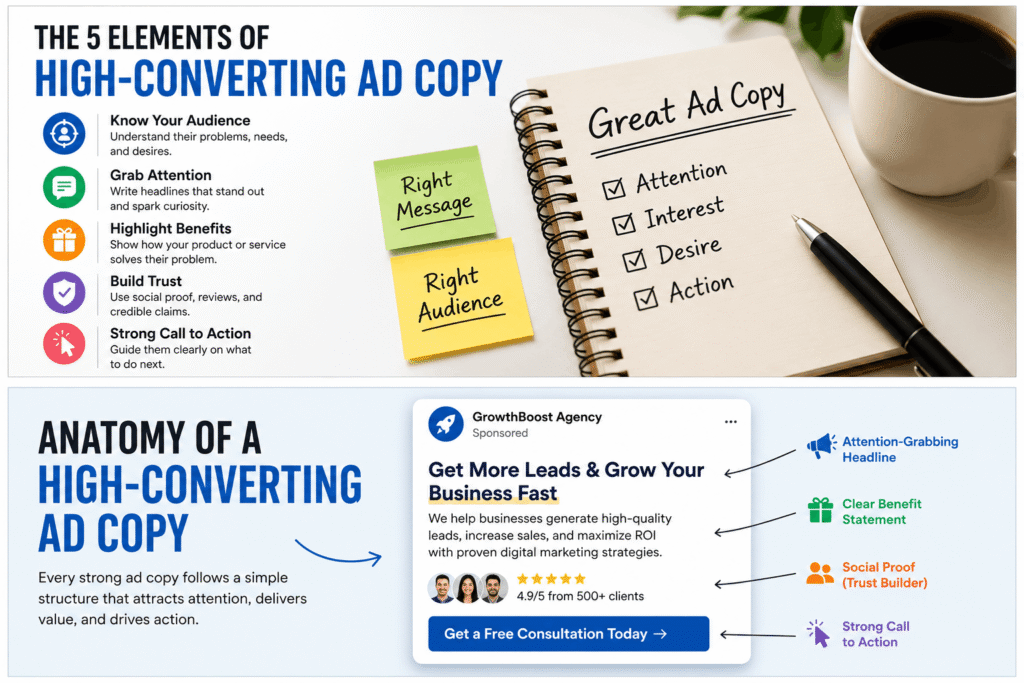
Every advertisement should guide readers toward a specific action.
Common examples include:
- Get Started Today
- Request a Free Consultation
- Claim Your Offer
- Download Now
- Learn More
- Book Your Appointment
A strong call to action creates momentum and removes uncertainty.
Step 7: Add Numbers and Social Proof
People naturally trust evidence.
You can strengthen your ad copy by including:
- Customer reviews
- Ratings
- Testimonials
- Case studies
- Statistics
- Industry awards
For example:
- Trusted by more than 5,000 customers
- Rated 4.9 out of 5 stars
- Generated over 10,000 qualified leads
These details increase credibility and encourage potential customers to take action.
Step 8: Test Different Versions of Your Copy
Even experienced marketers rarely create the perfect advertisement on their first attempt.
Test different elements, including:
- Headlines
- Calls to action
- Images
- Offers
- Descriptions
- Keywords
Small changes can produce significant improvements in performance.
A Simple Formula for Writing Better Ads
You can follow this simple structure:
Problem → Solution → Benefit → Call to Action
For example:
Struggling to generate more leads? Our marketing experts help businesses attract high-quality customers and increase revenue. Book your free consultation today.
This formula works exceptionally well across multiple advertising platforms.
Common Mistakes to Avoid
Here are some common errors that reduce advertising performance:
- Using complicated language
- Ignoring customer pain points
- Writing weak headlines
- Including too much information
- Forgetting the call to action
- Making unrealistic promises
- Failing to test different variations
Avoiding these mistakes can dramatically improve your results.
Final Thoughts
Writing high-converting ad copy isn’t about using complicated words or clever tricks. It’s about understanding your audience, identifying their needs, presenting a clear solution, and motivating them to take action.
The best advertisements don’t feel like advertisements at all. They feel like solutions to real problems.
The next time you create an advertising campaign, remember one simple principle: speak directly to your audience, focus on the value you provide, and always give people a reason to click.
When you master these fundamentals, you’ll create ads that not only attract attention but also generate meaningful business growth.