Google Ads for Beginners: How to Set Up Your First Campaign Without Wasting Money

Google Ads for Beginners: How to Set Up Your First Campaign Without Wasting Money

Running advertisements on Google can feel overwhelming when you’re just getting started. With so many campaign types, bidding options, targeting settings, and keyword strategies, it’s easy to spend money without seeing any real results.

The good news is that you don’t need a massive budget to run a successful campaign. Even with a modest investment, you can attract qualified leads, increase website traffic, and generate sales—provided you set up your campaign correctly from the beginning.

In this guide, you’ll learn exactly how to launch your first Google Ads campaign while avoiding the mistakes that cost beginners both time and money.

Google Ads is Google’s online advertising platform that allows businesses to display advertisements on Google Search, YouTube, Gmail, Google Maps, and millions of partner websites.

Whenever someone searches for a product or service, Google shows the most relevant advertisements based on factors such as:

  • Keywords
  • Ad quality
  • Competition
  • Budget
  • Landing page experience

Unlike traditional advertising, Google Ads allows you to pay only when someone clicks on your advertisement. This model is known as Pay-Per-Click (PPC) advertising.

Why Should Beginners Start Using Google Ads?

Google Ads provides several advantages, especially for small businesses and startups.

Immediate visibility

Unlike SEO, which can take months to produce results, Google Ads can start generating traffic almost immediately.

Better targeting

You can reach users based on:

  • Location
  • Age
  • Device type
  • Search intent
  • Interests

Budget control

You have complete control over how much you spend each day.

Measurable results

Every click, conversion, and interaction can be tracked.

Step 1: Define Your Goal Before Spending Money

Many businesses fail because they launch campaigns without defining a clear objective.

Ask yourself the following questions:

  • Do you want more website traffic?
  • Are you trying to generate leads?
  • Do you want more phone calls?
  • Are you selling products online?

Your campaign structure should always align with your primary goal.

For example:

GoalRecommended Campaign
Website trafficSearch campaign
Lead generationSearch campaign
Brand awarenessDisplay campaign
Product salesShopping campaign
Video viewsYouTube campaign

Step 2: Choose the Right Campaign Type

Google offers several campaign formats, but beginners should focus on Search campaigns first.

Search Campaigns

Your advertisements appear when users search for specific keywords.

Example:

If someone searches for:

Your advertisement may appear at the top of the search results.

Conduct Proper Keyword Research

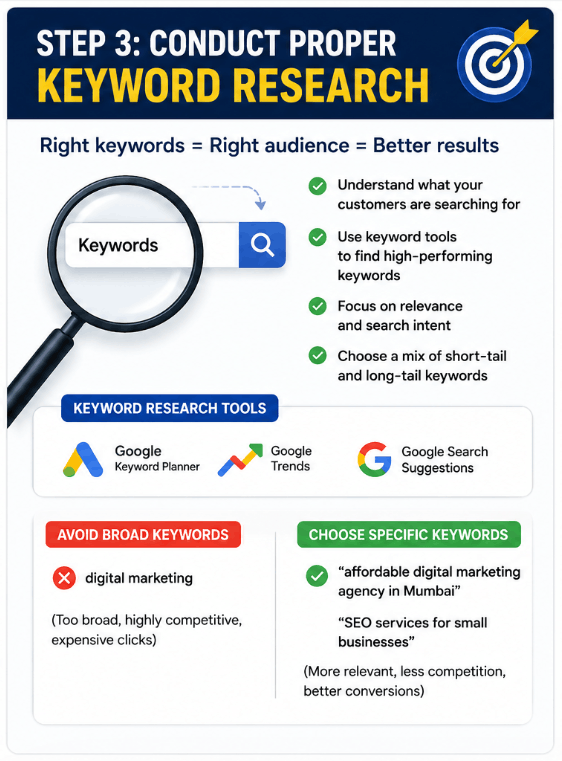
Step 3: Conduct Proper Keyword Research

Keywords determine when your advertisements appear.

Instead of targeting broad terms such as:

❌ Digital marketing

Try more specific keywords like:

✅ Affordable digital marketing agency in Mumbai

✅ SEO services for small businesses

Free keyword research tools

Step 4: Understand Keyword Match Types

Selecting the right keyword match type can save a significant amount of money.

Match TypeExampleUsage
Broad matchdigital marketing servicesMaximum reach
Phrase match“digital marketing services”Better control
Exact match[digital marketing services]Highly targeted

Phrase and exact match keywords are usually better options for beginners.

Step 5: Create a Realistic Budget

One of the biggest mistakes new advertisers make is investing too much money too quickly.

Start with a smaller budget and increase it gradually as you collect data.

A beginner-friendly budget might look like this:

ExpenseDaily Budget
Search campaign₹500
Display campaign₹300
Remarketing campaign₹200

This approach helps you understand what is working before scaling your spending.

Conduct Proper Keyword Research

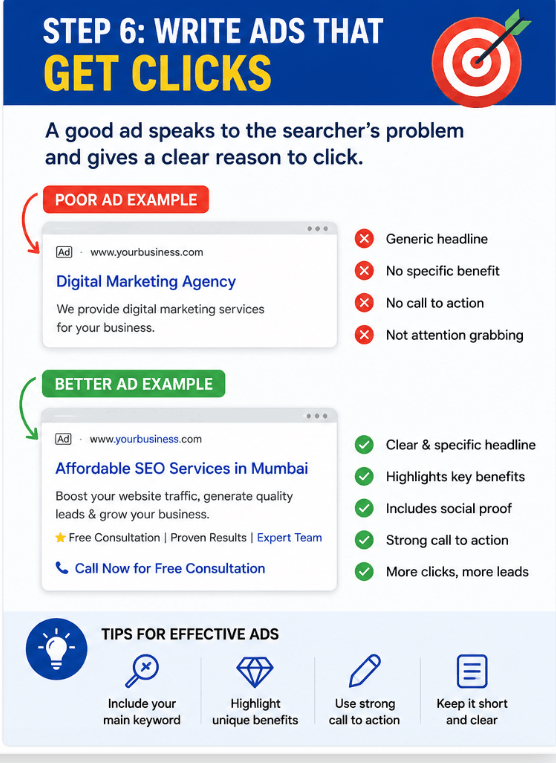
Step 6: Write Advertisements That Encourage Clicks

Your advertisement should address the user’s problem and present a clear solution.

Poor advertisement example

Headline: Digital Marketing Agency

Description: We provide marketing services.


Better advertisement example

Headline: Affordable SEO Services in Mumbai

Description: Increase traffic, generate leads, and grow your business. Get a free consultation today.


Tips for writing effective advertisements

  • Include your main keyword.
  • Highlight benefits instead of features.
  • Add numbers whenever possible.
  • Use a strong call to action.
  • Keep your message concise. 

Step 7: Optimize Your Landing Page

Even the best advertisement won’t produce results if users land on a slow or confusing page.

Your landing page should include:

  • A compelling headline
  • Fast loading speed
  • Mobile responsiveness
  • Customer reviews
  • Clear contact information
  • Simple forms

Remember that Google rewards high-quality landing pages with better ad placements and lower costs.

Step 8: Add Negative Keywords

Negative keywords prevent your advertisements from appearing for irrelevant searches.

Suppose you sell premium services.

You may want to exclude terms such as:

  • Free
  • Cheap
  • Internship
  • Job
  • Tutorial

This small adjustment can significantly reduce unnecessary spending.

Step 9: Set Up Conversion Tracking

Many beginners focus only on clicks.

Successful advertisers focus on conversions.

Track important actions, including:

  • Phone calls
  • Form submissions
  • Purchases
  • Newsletter subscriptions

Without proper tracking, you won’t know whether your campaign is profitable.

Common Google Ads Mistakes Beginners Should Avoid

Ignoring keyword research

Choosing the wrong keywords can waste your budget very quickly.

Using broad targeting

Targeting everyone usually results in poor performance.

Sending traffic to the homepage

A dedicated landing page often performs much better.

Not testing advertisements

Create multiple variations and compare the results.

Increasing budgets too quickly

Allow your campaign enough time to gather data before making major changes.

A Simple Beginner Strategy

If you’re starting from scratch, follow this plan:

  1. Create a Search campaign.
  2. Choose five to ten targeted keywords.
  3. Set a daily budget.
  4. Write two versions of the advertisement.
  5. Add negative keywords.
  6. Track conversions.
  7. Review results weekly.

Consistency matters much more than spending a large amount of money.

Final Thoughts


Google Ads can become one of the most effective marketing channels for businesses of any size. However, success doesn’t come from spending more money; it comes from spending money intelligently.

Start small, test continuously, analyse your data, and improve your campaigns over time. By following the strategies outlined in this guide, you’ll be able to launch your first Google Ads campaign confidently while avoiding the costly mistakes that many beginners make.

If you treat Google Ads as an ongoing process rather than a one-time setup, you’ll have a much greater chance of achieving long-term success.

Leave a Comment

Your email address will not be published. Required fields are marked *