Traditional lead generation used to mean cold-calling hundreds of numbers, sorting through messy spreadsheets, and manually guessing which website visitors might actually buy. It was time-consuming, expensive, and heavily reliant on trial and error.
Today, artificial intelligence has completely rewritten the playbook. Modern organizations are transitioning from manual pipelines to automated, intelligent ecosystems. By embedding machine learning, predictive analytics, and conversational agents into their workflows, companies are scaling their revenue operations without linearly scaling their headcount.
Here is a look at how businesses are leveraging AI to automate their sales funnels and drive predictable growth.
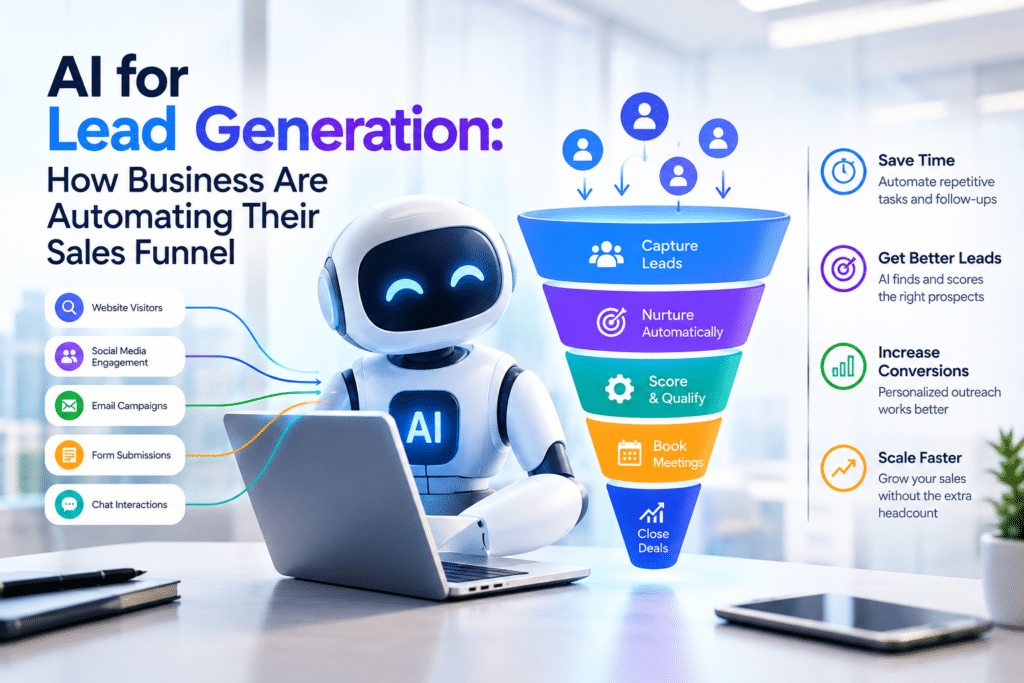
1. Smarter Prospecting and Lead Scoring
Finding leads is no longer just about casting a wide net; it’s about precision. AI-driven tools scan thousands of public data points, social profiles, and web domains in minutes to build hyper-targeted prospect lists that match an organization’s Ideal Customer Profile (ICP).
Once prospects enter the ecosystem, automated lead scoring takes over. Instead of reps manually reviewing form fills, machine learning algorithms analyze real-time behavioral signals—such as email engagement, page depth, and content downloads—to score leads instantly. High-priority leads are flagged and routed to sales teams while they are still active, drastically reducing response times.
2. 24/7 Engagement via Conversational AI
Buyers expect instant gratification. If a prospect visits a website at midnight with a technical question, waiting until the next business day for a response can mean losing them to a competitor.
Instant Qualification: AI-powered chatbots do more than just say hello. They ask targeted screening questions regarding budget, timeline, and core challenges.
Seamless Routing: Based on the answers, the bot can segment the visitor into a Marketing Qualified Lead (MQL) or Sales Qualified Lead (SQL), answer product queries, and coordinate calendar availability to book meetings automatically.
3. Hyper-Personalized Lead Nurturing at Scale
Generic blast emails no longer work. Modern buyers demand relevance, and AI makes delivering it at scale achievable.
AI-powered email automation platforms dynamically adjust copy, subject lines, and send times based on an individual’s past behavior and interaction history. If a lead stalls in the middle of the funnel, automated triggers deploy targeted case studies or product comparisons to keep them warm—all without requiring a human marketer to hit “send.”
4. Predictive Analytics and Funnel Optimization
One of the most powerful aspects of an AI-driven sales funnel is its ability to look ahead. Predictive analytics use historical conversion data and active pipeline signals to forecast future buying patterns and flag potential churn risks.
Furthermore, AI continuously monitors end-to-end funnel performance to spot bottlenecks. If conversion rates drop at a specific checkout or booking stage, the system highlights the friction point, giving revenue teams the data they need to pivot quickly.
Best Practices for Implementing an AI Sales Funnel
While automation transforms efficiency, technology works best when paired with human strategy. To successfully integrate AI into your sales process, keep these principles in mind:
Prioritize Data Quality: AI models rely heavily on clean data. Ensure your CRM records and customer insights are accurate to avoid skewed lead scoring.
Keep the Human Touch: Use AI to handle repetitive tasks—like scheduling, data entry, and initial qualification—so your sales reps can focus on what they do best: building relationships and closing deals.
Start with an MVP: Don’t try to automate your entire funnel overnight. Begin with a single high-impact area, such as an inbound qualification chatbot or automated follow-up sequences, and expand as your team adapts
The Bottom Line
AI sales automation is no longer a futuristic concept reserved for tech giants. It is a foundational backbone for businesses looking to operate efficiently in a competitive landscape. By automating the repetitive grind of lead generation and nurturing, companies can respond faster, convert smarter, and unlock sustainable revenue growth.
What stage of your sales funnel currently consumes the most manual effort for your team?