If you spend any time on LinkedIn or tech Twitter, you’ve likely been hit by two conflicting waves of panic. One day, you read that AI is writing better copy, designing cleaner ads, and analyzing data faster than any human, spelling total doom for marketing professionals. The next day, you hear that AI is just a tool, and human creativity can never be replaced.
So, what is the actual truth?
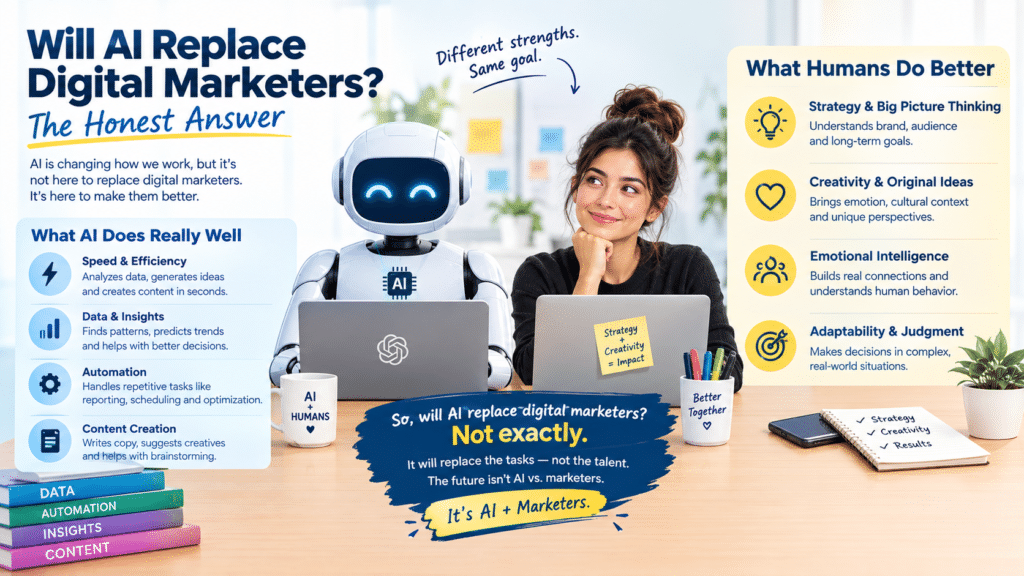
The honest answer is no, AI will not replace digital marketers. But AI is already replacing digital marketing tasks—and a job built entirely on those tasks is disappearing.
Let’s cut through the hype and look at what is changing, what is staying the same, and how you can ensure you’re on the winning side of the shift.
1. What AI Has Already Taken (The Death of Routine Execution)
To understand where the industry is heading, we have to look at what machines do better, faster, and cheaper than us. Execution-heavy busywork is effectively automated:
First-Draft Content: Generating basic blog outlines, generic social media captions, and product descriptions takes seconds for an LLM.
Creative Production Volume: AI tools can instantly resize creatives, swap backgrounds, and generate dozens of thumbnail variations.
Manual Campaign Tweaks: Platforms powered by smart bidding, Google Performance Max, and Meta Advantage+ make real-time adjustments better than manual human micromanagement.
Routine Reporting: Exporting metrics, plugging them into an AI workspace, and summarizing a performance deck takes minutes instead of hours.

If a digital marketer’s entire value proposition was “I write 10 basic blog posts a week and pull weekly Excel charts,” that job is under serious pressure.
2. What AI Cannot Touch (The Irreplaceable Human Edge)
AI is an extraordinary engine, but it lacks intent, skin in the game, and genuine human connection. Several core components of marketing remain uniquely human:
Strategy & Offer Design: Deciding what a business should sell, at what price point, to solve which specific consumer problem requires deep business judgment, market awareness, and empathy.
Customer Empathy: True insights rarely come from an automated prompt; they come from listening to raw customer feedback, analyzing real support tickets, and understanding cultural nuances.
Accountability: When a campaign burns through thousands of dollars and misses its target, an algorithm cannot step into the boardroom to explain why, realign the stakeholders, and fix the trajectory.
Brand Taste & Vision: AI can generate a thousand variations of an ad, but it takes a human brand director to know which one aligns with the company’s soul and long-term vision.
The takeaway: AI handles the how, but humans must decide the what, why, and who.
3. The Shift: From "Task Doer" to "System Director"
The modern digital marketer’s job description has fundamentally shifted. Instead of spending 80% of your time on manual production and 20% on thinking, those ratios have flipped.
Before AI: You were a manual creator, fighting to keep up with output volume.
In the Age of AI: You are a director. One marketer utilizing AI effectively can now achieve the throughput and output of a small team. However, you are entirely responsible for quality control, ethical alignment, and strategic direction.
4. How to Future-Proof Your Marketing Career
If you want to thrive rather than just survive in this landscape, focus your energy where machines fall short:
Own the Measurement Layer: AI systems are only as smart as the data fed into them. Master Google Analytics 4 (GA4), conversion tracking, data hygiene, and offline conversions. Being the person who ensures tracking is accurate makes you invaluable.
Move from Tasks to Outcomes: Shift how you present your value. Stop measuring success by “wrote 15 emails and ran 3 ads.” Measure it by “decreased customer acquisition cost by 20% and restructured our funnel for a higher lifetime value.”
Sharpen Soft Skills: Communication, client management, cross-functional collaboration with sales and product teams, and the courage to push back against a bad strategy are traits an algorithm can never replicate.
Embrace AI as Your Co-Pilot: Stop competing with AI and start leveraging it. Use it to break writer’s block, scale creative testing, and accelerate data analysis so you can spend your cognitive energy on high-level strateg
Final Verdict
AI is not going to replace digital marketers. But marketers who use AI will replace marketers who don’t.
Treat AI not as a threat to your livelihood, but as the ultimate force multiplier. When you stop acting like a robot doing repetitive tasks, you unlock the space to become a true strategic driver of business growth.
How are you currently integrating AI tools into your day-to-day marketing workflows?