If you have ever managed a pay-per-click (PPC) campaign, you have likely looked at your dashboard and wondered what that 1-to-10 rating next to your keywords actually means.
That number is your Quality Score, and it is arguably the single most important metric in your Google Ads account. Far from being a mere vanity metric, Quality Score acts as the economic engine of your campaigns. It dictates whether your ads secure prime real estate on the search engine results page (SERP) or get buried, and more importantly, it dictates how much money you pay every time someone clicks your ad.
Understanding how Quality Score works can mean the difference between a profitable marketing channel and a campaign that drains your budget.
What Is Google Ads Quality Score?
Quality Score is Google’s rating of the overall quality and relevance of your keywords, ad copy, and landing pages. Rated on a scale from 1 (lowest) to 10 (highest), Google assigns this score to individual keywords in your account.
Google’s ultimate business objective is user satisfaction: when someone types a query into the search bar, they want immediate, accurate, and helpful answers. If advertisers could simply pay massive amounts of money to show irrelevant or spammy websites, user trust would plummet.
To solve this, Google introduced Quality Score as a way to reward advertisers who focus on user experience and penalize those who don’t.
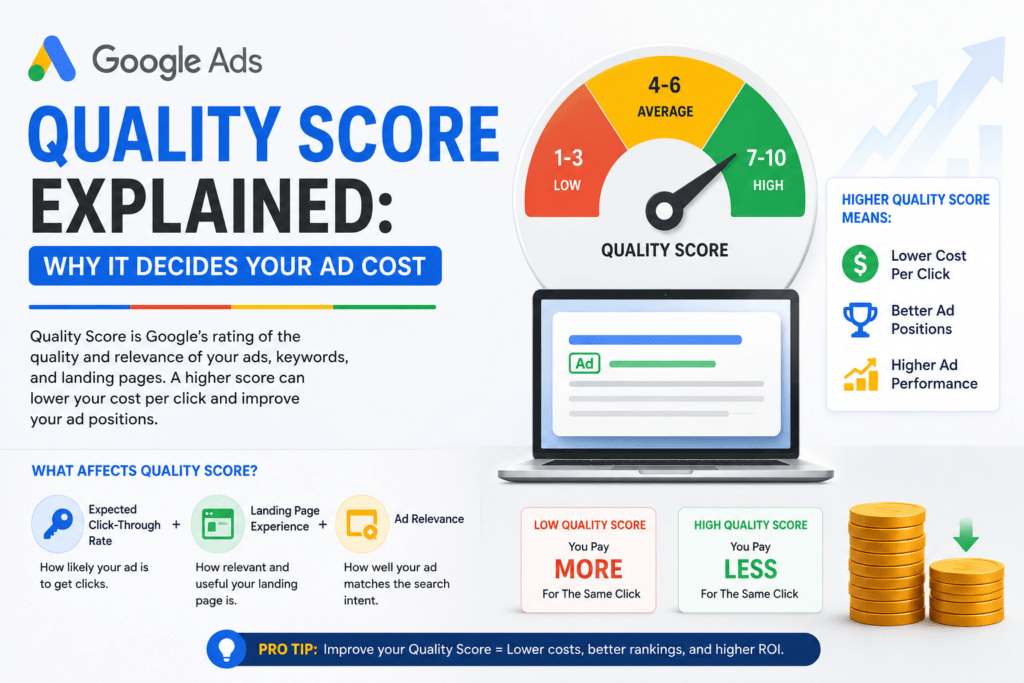
The Three Pillars of Quality Score
Expected Click-Through Rate (CTR): This is Google’s prediction of how likely people are to click your ad when they search for that specific keyword, based on historical performance. It measures whether your ad copy is compelling enough to catch the user’s eye.
Ad Relevance: This measures how closely your ad text matches the user’s search intent. If someone searches for “waterproof hiking boots,” an ad about general outdoor gear has low relevance, whereas an ad explicitly offering waterproof hiking boots has high relevance.
Landing Page Experience: This evaluates what happens after the click. Google checks whether your landing page is fast, mobile-friendly, transparent, easy to navigate, and directly delivers on the promise made in the ad copy
How Quality Score Decides Your Ad Cost (The Ad Rank Formula)
Many beginners assume that the Google Ads auction is simple: highest bidder wins. If Advertiser A bids $3 and Advertiser B bids $5, Advertiser B should take the top spot, right?
Not quite. Google uses a metric called Ad Rank to determine both your position on the page and what you actually pay. The basic formula looks like this:
$$\text{Ad Rank} = \text{Maximum CPC Bid} \times \text{Quality Score}$$Because Quality Score multiplies your bid, a high Quality Score can compensate for a lower financial bid.
A Real-World Cost Example:
Imagine two competing businesses bidding on the exact same keyword:
Competitor A has a maximum bid of $4.00 but a poor Quality Score of 3.
Ad Rank: $4.00 \times 3 = \mathbf{12}$
Your Business has a maximum bid of $2.50 but a strong Quality Score of 8.
Ad Rank: $2.50 \times 8 = \mathbf{20}$
Even though your maximum bid is significantly lower than your competitor’s, your Ad Rank is higher (20 vs. 12). This means you win the top ad position, while paying a lower actual cost-per-click (CPC) than your competitor. Google actively discounts clicks for high-quality advertisers because you are creating a better experience for its users.
Why a Low Quality Score Bleeds Your Budget
Conversely, running campaigns with a low Quality Score (anything below 5) acts as an invisible tax on your advertising:
Inflated Cost-Per-Click (CPC): To make up for a low score, you have to bid exponentially higher just to show up in a decent position.
Disadvantaged Ad Placement: Your ads may get pushed to the bottom of the page or excluded from the auction entirely.
Lower ROI: Higher costs per click combined with lower visibility mean fewer conversions for a much higher ad spend.
Actionable Tips to Improve Your Quality Score
Improving your Quality Score is not an overnight fix because it relies heavily on historical data, but systematic changes yield steady improvements:
Tighten Your Ad Groups: Don’t cram 50 keywords into a single ad group. Group keywords into small, hyper-themed buckets (e.g., 5 to 10 closely related keywords) so you can write ad copy that matches them precisely.
Write Intent-Driven Ad Copy: Incorporate the exact search phrases users are typing into your headlines and descriptions. The more relevant your ad looks to the searcher, the higher your expected CTR will climb.
Optimize Your Landing Pages: Ensure your landing pages load quickly, look great on mobile devices, and give the user an immediate answer to what they searched for.
Leverage Negative Keywords: Regularly audit your search term reports and add negative keywords to filter out irrelevant traffic. This prevents wasted clicks and boosts your overall click-through rate
Summary
Quality Score is Google’s way of keeping the digital advertising ecosystem healthy. By shifting your focus away from simply throwing more money at a campaign and toward optimizing relevance, user experience, and ad copy precision, you can dramatically drop your advertising costs while driving better business results.