Setting a Pay-Per-Click (PPC) advertising budget for a small business in India requires a delicate balance between financial caution and aggressive growth ambitions. Unlike large corporations with massive cash reserves, small business owners must treat every rupee spent on platforms like Google Ads and Meta Ads as a high-stakes investment that demands a measurable return.
The Indian digital ecosystem is uniquely diverse, highly competitive, and cost-conscious. From hyper-local service providers in bustling Tier 2 cities to D2C e-commerce brands shipping nationwide, arriving at the right budget isn’t a guessing game—it’s a calculated science.
Here is a practical, step-by-step framework to help you set a smart PPC budget that drives predictable growth without burning through your capital
1. Define Your Business Model and Core Metrics
Before opening your ads manager, you must establish what success looks like. PPC budgeting begins with your end goal, and how you calculate your budget depends entirely on whether you are a Lead Generation business or an E-commerce store.
For Lead Generation (Services, Real Estate, Education, B2B): You need to understand your Customer Lifetime Value (LTV) and acceptable Cost Per Acquisition (CPA). If a client is worth ₹50,000 to your business over their lifecycle, you can comfortably afford to spend ₹5,000 to acquire them.
For E-commerce (Retail, D2C Brands): Your focus should be on Return on Ad Spend (ROAS), Average Order Value (AOV), and your product profit margins. If you want ₹5,000,000 in monthly sales at a target 4x ROAS, your monthly ad budget is automatically mapped out.
2. Conduct Indian Market and Keyword Research
India is a massive market where search volumes, consumer intent, and Cost-Per-Click (CPC) vary wildly based on geography, industry, and language.
Use tools like the Google Keyword Planner to research your core keywords and see what competitors are paying. Keep these regional factors in mind:
Tier 1 Cities (Mumbai, Bengaluru, Delhi, etc.): High competition, high search volume, and significantly higher CPCs.
Tier 2 & Tier 3 Cities: Lower click costs, but require careful localization, regional nuance, and sometimes vernacular ad copy.
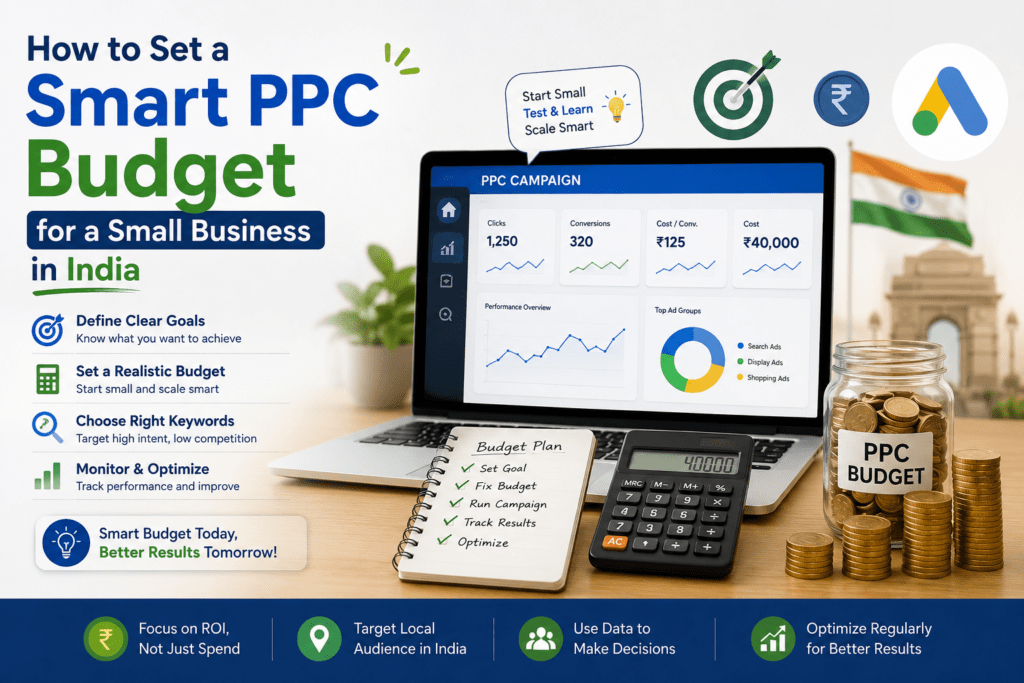
Estimate your average CPC. For competitive sectors in India—such as finance, real estate, or specialized healthcare—CPCs can range from ₹20 to over ₹150. Multiplying your expected CPC by the number of clicks needed to get a conversion will give you a realistic financial baseline.
3. Avoid the "Micro-Budget" Trap
One of the most common mistakes small business owners make is testing PPC with an arbitrary, micro-budget (like ₹100 or ₹200 a day) in a high-cost industry.
Google Ads and Meta Ads rely on machine learning algorithms that need a steady stream of data to optimize. If your budget is too restrictive:
Your ads won’t get enough daily impressions and clicks.
Your campaigns will get stuck in a permanent “learning phase.”
You’ll spend weeks gathering data that could have been collected in days.
As a rule of thumb, your starting daily budget should comfortably afford at least 10 to 15 clicks per day, or enough to secure 2 to 3 daily conversions. For most local service businesses in India, a starting monthly budget of ₹15,000 to ₹25,000 across Google and Meta is the minimum sweet spot to generate meaningful traction.
4. Eliminate Waste with Smart Targeting
A smart budget isn’t just about how much you spend; it’s about where and when you spend it. To maximize a tight budget, plug these efficiency leaks:
Geographic Targeting: Don’t run ads nationwide unless you ship nationwide. Hyper-local targeting or precise state-level segmentation ensures your money is only spent where your actual customers live.
Ad Scheduling: Unless you run an automated e-commerce store, pause your ads during non-business hours. There is no point paying for midnight clicks if nobody is awake to answer the phone or process leads.
Device Optimization: Mobile traffic dominates India. Ensure a hefty chunk of your budget drives traffic to fast-loading, mobile-optimized landing pages where users can easily call or fill out a form.
5. Scale Gradually and Track Everything
Once your campaign goes live, your budget should never be a “set-and-forget” affair. Integrate conversion tracking, Google Analytics, and your CRM to see exactly which keywords, ads, and campaigns are turning ad spend into actual revenue.
The Scaling Rule: If a campaign consistently meets your target CPA or delivers a profitable ROAS, scale the budget incrementally by 15% to 20% every week. Doubling your budget overnight can shock the algorithm and spike your cost-per-conversion.
Cut the Fat: Ruthlessly pause keywords or audience segments that drain your budget without generating conversions after a fair testing period.
Final Thoughts
Finally, effective budgeting is an iterative, dynamic process rather than a static decision made once a year. Small businesses must adopt a mindset of continuous tracking, attribution modeling, and budget reallocation. By integrating conversion tracking, Google Analytics, and CRM systems, business owners can pinpoint exactly which campaigns, ad groups, and keywords are driving profitable conversions and which are draining capital. The golden rule for scaling is simple: once a campaign consistently delivers a positive ROAS or meets the target CPA, incrementally increase the budget by twenty percent every week to ten days rather than doubling it overnight, which can destabilize the algorithm. By combining meticulous upfront research, a realistic understanding of Indian consumer costs, and disciplined performance monitoring, small businesses can deploy a smart PPC budget that drives sustainable growth, maximizes profitability, and outperforms competitors in the digital marketplace.