You can spend hours planning a video, recording it, editing it, and finally uploading it to YouTube. But what happens next?
Sometimes, nothing.
The video is live, but the views don’t come. Your subscribers don’t increase, and your carefully edited content seems to disappear into the huge ocean of videos already on YouTube.
If you’ve experienced this, you’re not alone.
The problem isn’t always the quality of your content. Sometimes, people simply aren’t finding it.
That’s where YouTube SEO becomes important.
YouTube is more than just a platform for watching videos. It’s also a search engine. In fact, millions of people use it every day to learn something, solve a problem, compare products, discover new ideas, or simply find answers to questions they have.
Google also shows videos in its search results when it believes that a video can answer a user’s query better than text alone.
So, if you understand how YouTube SEO works, you can give your videos a much better chance of being discovered by the right people.
In this guide, we’ll look at practical ways to optimize your videos, improve their visibility, and increase your chances of appearing in both YouTube and Google search results.
In simple terms, YouTube SEO means optimizing your videos so that YouTube and Google can understand what your content is about and show it to people who are interested in that topic.
Think about it this way.
If you create a video called “How to Start Digital Marketing as a Beginner,” YouTube needs to understand that your video is related to digital marketing, beginners, and learning how to get started.
It looks at different signals to understand this, including your title, description, the actual content of your video, and how viewers interact with it.
But there’s something important to remember.
YouTube SEO isn’t just about putting keywords everywhere.
You could have the perfect keyword in your title and description, but if viewers click on your video and leave after 20 seconds, that’s a problem.
The best YouTube SEO strategy combines two things:
Helping YouTube understand your content and giving viewers a reason to keep watching.
Both matter.
Why Should You Care About YouTube SEO?
Let’s say you publish a video today.
If you don’t optimize it properly, you might get a few views from your existing followers and then see the traffic slowly disappear.
But if your video targets a topic people are actively searching for, things can be very different.
Someone might search for that topic next week. Or next month. Or even a year from now.
If your video is useful and continues to perform well, it can keep bringing in viewers long after you originally published it.
That’s one of the biggest advantages of search-driven content.
Good YouTube SEO can help you:
- Reach people who are actively looking for your content
- Get more organic views
- Attract relevant subscribers
- Build authority in your industry
- Drive traffic to your website
- Generate leads for your business
- Promote products or services
- Build a stronger personal brand
The key word here is relevant.
Getting 100,000 random views isn’t necessarily better than getting 10,000 views from people who genuinely care about what you offer.
Start With Keyword Research
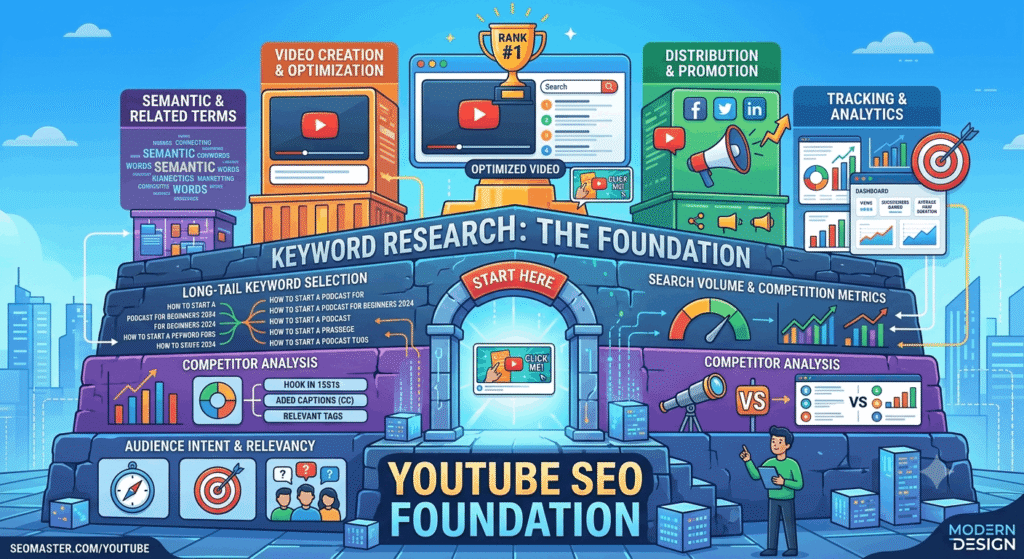
Before you even press the record button, spend some time figuring out what people are searching for.
This is one of the easiest steps to overlook, especially when you’re excited about a new video idea.
Let’s say you want to make a video about digital marketing.
You could simply title it:
“Digital Marketing Tips”
There’s nothing technically wrong with that, but it’s quite broad.
Instead, you could explore more specific searches:
- Digital marketing for beginners
- How to learn digital marketing
- Digital marketing strategies for small businesses
- How to get clients with digital marketing
- Best digital marketing skills to learn
These topics give you a much clearer idea of what the viewer actually wants.
Use YouTube's Search Bar
One of the simplest ways to find ideas is to start typing a topic directly into YouTube.
YouTube will automatically suggest related searches.
For example, type:
“YouTube SEO…”
You might see suggestions related to:
- YouTube SEO tips
- YouTube SEO for beginners
- How to rank YouTube videos
- YouTube keyword research
These suggestions can give you a good starting point because they reflect the types of searches people make on the platform.
Look at Google Too
Don’t limit your research to YouTube.
Search the same topic on Google and see what appears.
If you notice videos showing up prominently in the results, that’s a good indication that Google considers video content useful for that particular search.
You can also look at the “People Also Ask” section and related searches to discover questions your audience might have.
Check What Your Competitors Are Doing
Spend some time looking at successful channels in your niche.
Look at the videos that are getting the most views.
Ask yourself:
- What topics are they covering?
- How are they writing their titles?
- What do their thumbnails look like?
- How long are their videos?
- What questions are they answering?
- What are viewers saying in the comments?
The idea isn’t to copy them.
Instead, look for gaps.
Maybe they have explained a topic in a very basic way, while you can provide a more detailed tutorial. Or perhaps their video is several years old and you can create a newer, updated version.
That’s where you can add your own value.
Create a Title That Makes People Want to Click
our video title has two jobs.
First, it should help YouTube understand your topic.
Second, it should make a real person want to click.
That’s a balance worth getting right.
For example:
Digital Marketing Tips
is fairly generic.
A title like:
10 Digital Marketing Tips Every Beginner Should Know
is more specific.
And something like:
10 Digital Marketing Tips to Help Beginners Get Their First Client
creates a stronger reason to watch.
The important thing is to avoid misleading people.
You might get clicks by making exaggerated promises, but if the video doesn’t deliver, viewers will leave quickly. That can hurt the overall performance of your content.
A good title should make a promise you can actually keep.
Don't Ignore Your Video Description
The description is another place where you can explain what your video is about.
You don’t need to write a giant block of keywords.
Instead, write a short, natural introduction that tells viewers what they’ll learn.
For example:
In this video, we’ll look at practical YouTube SEO strategies that can help your videos get discovered on YouTube and Google. We’ll cover keyword research, titles, thumbnails, descriptions, audience retention, and other factors that can influence your video’s visibility.
After that, you can include relevant links, resources, timestamps, or a link to your website.
Think of the description as an extension of your video. It should be useful rather than stuffed with keywords.
Your Thumbnail Can Make or Break Your Video
Imagine that your video appears in front of 10,000 people.
Now imagine that only a small percentage of those people click it.
Your content might be excellent, but if the thumbnail doesn’t catch attention, many people will never find that out.
That’s why thumbnails matter.
A good thumbnail should be:
- Simple
- Easy to understand
- Visually clear
- Relevant to the video
- Easy to read on a mobile screen
Try not to put too much information on it.
One strong visual idea is usually better than five different messages competing for attention.
Your title and thumbnail should also work together.
The title can explain the topic, while the thumbnail creates curiosity.
The First 30 Seconds Matter More Than You Think
Here’s a common mistake I see in many YouTube videos.
The creator spends the first 30 seconds saying:
“Hey guys, welcome back to my channel. If you’re new here, don’t forget to subscribe…”
By the time they finally get to the actual topic, the viewer has already left.
People are busy.
If they clicked your video because they want to learn something, give them a reason to stay.
Start by telling them what they’re going to get from the video.
For example:
“If your YouTube videos are getting impressions but very few views, there are a few things you can change. In this video, I’ll show you exactly what they are.”
That’s much more direct.
You don’t need to create unnecessary drama. Just give viewers a reason to continue.
Focus on Audience Retention
Getting someone to click your video is one thing.
Keeping them interested is another.
Audience retention tells you how much of your video people are actually watching.
If most viewers leave within the first minute, that’s a sign that something isn’t working.
Maybe the introduction is too long.
Maybe the video doesn’t match the title.
Maybe you’re taking too long to get to the point.
Look at your retention graph and try to understand where viewers are dropping off.
Over time, this can teach you a lot about your audience.
You may discover that people love your tutorials but lose interest during long introductions. Or perhaps your audience prefers shorter videos with more practical examples.
Use that information to improve your next video.
Make Your Videos Easy to Watch
Good information isn’t always enough.
The way you present it matters too.
Depending on your content, you can use:
- Screen recordings
- Examples
- Graphics
- Text overlays
- B-roll footage
- Charts
- Animations
- On-screen demonstrations
You don’t need expensive equipment or a Hollywood production budget.
In many cases, clear audio, good lighting, and useful content are more important than fancy effects.
The goal is simple:
Make it easy for people to understand and stay interested.
Use Keywords Naturally in Your Video
YouTube can understand the content of your video itself, not just the title and description.
So, if you’re making a video about YouTube SEO, talk naturally about YouTube SEO.
Discuss related topics such as keyword research, video titles, thumbnails, watch time, and audience retention.
You don’t need to repeat the same keyword every 30 seconds.
That’s not how natural conversation works, and it makes the content uncomfortable to watch.
Instead, focus on explaining your topic clearly.
If your video genuinely covers the subject, the relevant keywords will naturally appear in your speech.
Tags aren’t something you should obsess over.
They’re useful for providing additional context, particularly for things like common misspellings or variations of a term.
For a video about YouTube SEO, you might use tags such as:
- YouTube SEO
- YouTube SEO tips
- Video SEO
- How to rank YouTube videos
- YouTube marketing
But don’t expect tags alone to take your video from 100 views to 100,000 views.
Your content, title, thumbnail, viewer satisfaction, and overall performance are far more important.
How to Get Your YouTube Videos to Appear on Google
This is where things get interesting.
Your YouTube video doesn’t necessarily have to be discovered only through YouTube.
Google sometimes includes videos directly in its search results.
This is especially common for topics where watching something is more helpful than reading about it.
For example:
- How to edit a video
- How to fix a technical problem
- How to use software
- Product reviews
- Step-by-step tutorials
- Fitness demonstrations
- Cooking recipes
If you’re targeting a topic that people are likely to search on Google, create a video that genuinely answers the question.
The clearer and more useful your video is, the better chance it has of being discovered.
Create a Blog Around Your YouTube Video
If you have a website, you can take your YouTube SEO strategy one step further.
Let’s say you create a video titled:
“How to Do Keyword Research for YouTube.”
You could also write a detailed blog post about the same topic and embed your video inside it.
Now you have two pieces of content working together.
Someone might discover your blog through Google and then watch your video.
Another person might discover the video directly on YouTube.
You can also link between the two.
This creates a stronger content strategy and allows you to reach people through multiple channels.
Don't Forget About Playlists
Playlists are often overlooked.
But they’re a simple way to organize your content and encourage viewers to watch related videos.
For example, if you run a digital marketing channel, you could create playlists like:
- SEO for Beginners
- Google Ads Tutorials
- Social Media Marketing
- YouTube SEO
- Digital Marketing for Small Businesses
If someone watches one video and then continues watching another related video, you’ve created a longer viewing session.
That benefits both the viewer and your channel.
Use End Screens and Cards
Your video shouldn’t be a dead end.
When someone finishes watching, give them somewhere useful to go next.
You could recommend:
- Another related video
- A playlist
- Your latest upload
- Your channel
For example, if you’re making a video about keyword research, your next video could explain how to optimize a YouTube video using those keywords.
This creates a natural journey from one video to another.
Encourage Comments Without Begging for Them
You’ve probably heard creators say:
“Like, comment, share, subscribe, hit the bell, and follow me on Instagram…”
By the time they’ve finished, you’ve forgotten why you clicked the video in the first place.
There’s nothing wrong with asking viewers to engage, but it should feel natural.
Instead of simply saying:
“Comment below!”
ask a question related to your content.
For example:
“What’s the biggest problem you’re facing with your YouTube channel right now?”
That’s a much more natural way to start a conversation.
And the answers can give you ideas for future videos.
Check Your Analytics Regularly
If you’re serious about growing on YouTube, you need to pay attention to your data.
YouTube Analytics can tell you things like:
- How many people saw your thumbnail
- How many clicked
- How long they watched
- Where viewers came from
- Which videos gained subscribers
- Where people stopped watching
Don’t just look at the number of views.
Look for patterns.
Maybe one topic consistently performs better than others.
Maybe your audience watches your videos longer when they’re under 10 minutes.
Maybe your thumbnails get more clicks when they’re simpler.
These small observations can make a huge difference over time.
Common YouTube SEO Mistakes
Even experienced creators make mistakes.
Here are a few worth avoiding.
Targeting Keywords That Nobody Searches
Creating a video around a topic you’re interested in doesn’t necessarily mean there’s an audience for it.
Try to find the intersection between what you want to talk about and what your audience actually wants to know.
Using Clickbait
A strong title is good.
A misleading title is not.
If your title promises something that your video doesn’t deliver, viewers will lose trust.
Making Videos Too Long
Longer doesn’t automatically mean better.
If you can explain something in eight minutes, don’t stretch it to twenty just because you think longer videos are better for SEO.
Ignoring the Thumbnail
A great video with a weak thumbnail may never get the chance it deserves.
Giving Up Too Quickly
One video doesn’t define your channel.
Sometimes a video takes time to gain traction. Other times, it simply doesn’t perform.
Learn from it and move forward.
A Practical YouTube SEO Checklist
Before publishing your next video, take a few minutes to check the following:
- Have I chosen a clear topic?
- Is there a real audience for this topic?
- Did I research relevant keywords?
- Does my title clearly explain the value?
- Is my thumbnail easy to understand?
- Does the first 30 seconds give viewers a reason to stay?
- Is my description useful and natural?
- Have I added relevant chapters?
- Did I include captions?
- Have I linked to related videos?
- Did I add an end screen?
- Is the video part of a relevant playlist?
- Do I have a clear call to action?
- Will I check the analytics after publishing?
You don’t have to get everything perfect on your first attempt.
The goal is to get better with every upload.
Final Thoughts
YouTube SEO isn’t a magic formula.
There isn’t one secret keyword, tag, or trick that will suddenly make every video go viral.
The reality is much simpler.
Create content people actually want to watch. Understand what they’re searching for. Make your videos easy to find. Give them a reason to click. And once they click, give them a reason to stay.
That’s the foundation of good YouTube SEO.
Start by researching your audience and finding topics that genuinely solve problems or answer questions. Then optimize the basics: your title, thumbnail, description, and overall video structure.
After publishing, don’t just move on to the next video. Look at your analytics. See what worked. See where viewers left. Look at which topics attracted the most interest.
Then do it again.
Because the creators who grow consistently aren’t necessarily the ones who get everything right from day one. They’re the ones who keep learning, experimenting, and improving.
And if you combine that mindset with a solid YouTube SEO strategy, your videos have a much better chance of being discovered—not just today, but weeks, months, and sometimes even years after you publish them.