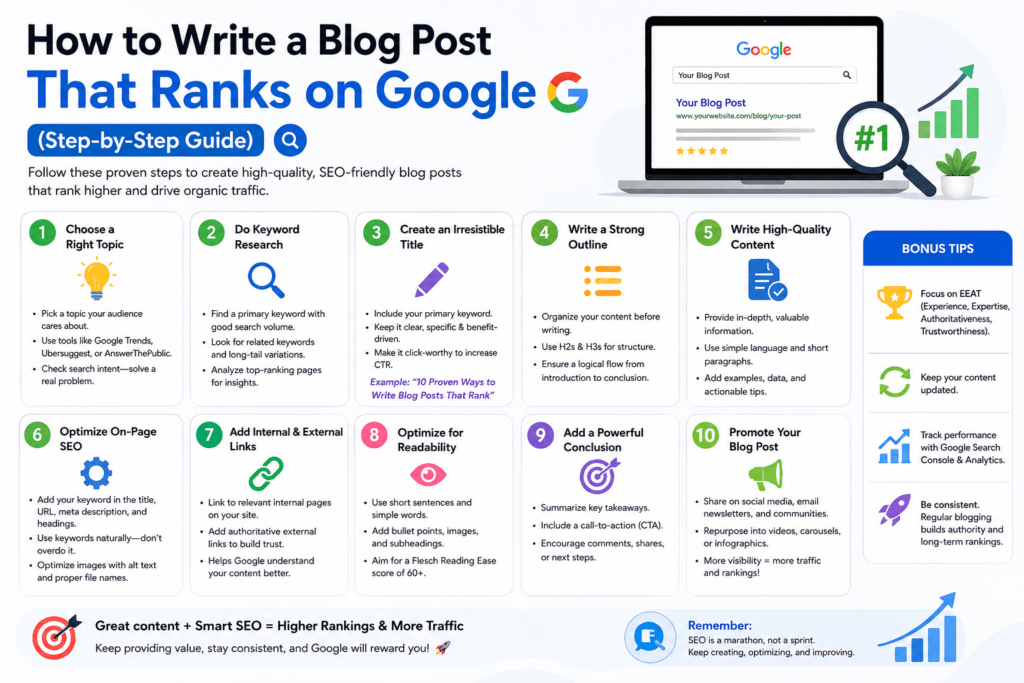
Writing a blog post that consistently claims the top spots on Google search engine results pages (SERPs) is no longer just about stuffing keywords or matching a specific word count. In today’s hyper-competitive digital landscape shaped by advanced AI search features, zero-click searches, and strict Google E-E-A-T (Experience, Expertise, Authoritativeness, and Trustworthiness) guidelines, content creation requires a rigorous, strategic approach.
Whether you are building organic traffic for an e-commerce store, a local service business, or a professional blog, mastering modern SEO copywriting is essential. This comprehensive, step-by-step guide will walk you through the exact blueprint required to research, structure, write, and optimize a blog post engineered to rank high and convert readers in 2026.
Phase 1: Strategic Planning & Keyword Research
Before writing a single sentence, you must ensure that there is a validated audience searching for your topic and that you understand the intent behind their search.
1. Identify Search Intent
Search intent—the “why” behind a user’s query—is Google’s top priority. If your content format does not match what searchers want, you will not rank, regardless of your domain authority. Search intent generally falls into four buckets:
Informational: The user wants to learn something (e.g., “How to fix a slow WordPress site”).
Navigational: The user is looking for a specific website or page (e.g., “Google Search Console login”).
Commercial: The user is researching before making a purchase decision (e.g., “Best SEO audit tools 2026”).
Transactional: The user is ready to buy or take immediate action (e.g., “Hire local digital marketing agency Kalyan”).
Actionable Tip: Look at the top three ranking results for your target keyword. Are they listicles, product pages, deep-dive guides, or video reviews? Match your format to what Google is already rewarding.
Phase 2: Building a Comprehensive Outline
Search intent—the “why” behind a user’s query—is Google’s top priority. If your content format does not match what searchers want, you will not rank, regardless of your domain authority. Search intent generally falls into four buckets:
Informational: The user wants to learn something (e.g., “How to fix a slow WordPress site”).
Navigational: The user is looking for a specific website or page (e.g., “Google Search Console login”).
Commercial: The user is researching before making a purchase decision (e.g., “Best SEO audit tools 2026”).
Transactional: The user is ready to buy or take immediate action (e.g., “Hire local digital marketing agency Kalyan”).
Actionable Tip: Look at the top three ranking results for your target keyword. Are they listicles, product pages, deep-dive guides, or video reviews? Match your format to what Google is already rewarding.
2. Choose Primary and Secondary Keywords
A well-structured outline guarantees that your content covers the topic comprehensively while satisfying semantic search requirements.
1. Map Out Semantic Subheadings (H2s and H3s)
Google evaluates your content based on topical authority. Your headings should answer the questions your audience is naturally asking. Use tools like Google’s “People Also Ask” box and related searches to discover sub-topics.
Structure your headings hierarchically (H1 for the title, H2s for main sections, H3s for supporting points).
Incorporate variations of your target keywords naturally into your subheadings.
2. Plan for Original Insights and Data
To stand out against AI-generated content flooding the web, your post must feature unique value:
Original case studies or client results.
Proprietary frameworks or step-by-step workflows.
Expert quotes, screenshots, or custom diagrams.
Phase 3: Writing the Content with E-E-A-T in Mind
With your outline ready, focus on crafting clear, engaging, and authoritative prose.
1. Craft an Irresistible Title (H1) and Introduction
Your title and introduction dictate your Click-Through Rate (CTR) and bounce rate.
The Title: Keep it under 60 characters, front-load your primary keyword, and include a compelling hook or modifier (e.g., …Step-by-Step Guide or …Proven Framework).
The Introduction: Keep it concise using the APP formula (Agree, Promise, Preview):
Agree with the reader’s pain point.
Promise a clear solution.
Preview what they will learn in the post.
2. Write for Scannability and Engagement
Online readers rarely read word-for-word; they scan. Optimize your readability score:
Keep paragraphs short (2 to 3 sentences maximum).
Use bulleted and numbered lists to break up dense blocks of text.
Incorporate blockquotes or callout boxes for important warnings, definitions, or pro tips.
3. Demonstrate First-Hand Experience (E-E-A-T)
Explicitly weave personal or agency experience into the narrative. Instead of writing generic statements like “SEO is important,” use experiential framing: “When managing performance campaigns and organic strategies since 2016, we noticed that…” This human touch signals authenticity to both human readers and Google’s quality raters.
Phase 4: Technical and On-Page SEO Optimization
Once your draft is complete, optimize it for search engine crawlers without sacrificing readability.
1. Strategic Keyword Placement
Place your primary keyword naturally in critical high-weight locations:
The URL slug (keep it short and descriptive, e.g.,
[yourdomain.com/write-blog-post-that-ranks](https://yourdomain.com/write-blog-post-that-ranks)).The first 100 words of the introduction.
At least one H2 heading.
Naturally sprinkled throughout the body text (aim for a natural keyword density of 1% to 1.5%, avoiding over-optimization).
2. Optimize Title Tags and Meta Descriptions
Your meta tags serve as your ad copy on the SERPs.
Title Tag: Keep under 60 characters, include the primary keyword, and add a power word.
Meta Description: Keep under 150 characters, summarize the core value proposition, and end with a clear call-to-action (e.g., “Learn the exact step-by-step framework to boost your organic traffic today. Read the full guide!”).
3. Internal and External Linking Structure
Links are the highways of the internet. They help search engines discover your pages and understand their relationships.
Internal Links: Link to 3 to 5 relevant pages, blog posts, or service offerings on your own website using descriptive anchor text.
External Links: Link out to authoritative, non-competing industry sources or research studies to back up your claims.
Phase 5: Multimedia Optimization & User Experience (UX)
Text alone is no longer enough to secure top rankings. Modern SEO requires a rich, engaging user experience.
1. Image Optimization and Alt Text
Every image on your blog post should be optimized for both speed and search visibility.
Compress images using modern formats like WebP to keep page load times under two seconds.
Write descriptive alt text for every image to assist screen readers and image search traffic.
Image Best Practices Note: Ensure every featured graphic or diagram includes a clear file name, descriptive alt text, an SEO-friendly meta description, and a concise caption explaining its context.
2. Mobile-First Responsiveness
Over 60% of web traffic originates from mobile devices. Test your blog post layout across mobile screens to ensure:
Text is legible without horizontal scrolling.
Buttons and internal links are easily tappable.
Pop-ups or lead capture forms do not block core content on mobile viewports.
Phase 6: Post-Publication Promotion & Continuous Maintenance
Publishing your article is only half the battle. To achieve and maintain top rankings, you must actively promote and update your content.
1. Multi-Channel Distribution
Share your new post across your professional social media channels and LinkedIn profiles.
Repurpose key sections of the article into short-form video scripts, carousels, or email newsletter summaries.
Reach out to industry peers or mentioned experts to encourage shares and backlinks.
2. Monitor Performance and Iterate
Track your rankings, impressions, and CTR using tools like Google Search Console and Google Analytics.
Identify keywords where your post ranks on page two (positions 11–20).
Update those sections with fresh data, expand on thin paragraphs, or add new internal links to push them onto page one.
Summary Checklist for Ranking Blog Posts
| SEO Step | Core Action Item |
| Intent Analysis | Match content format to what searchers and top-ranking competitors expect. |
| Keyword Strategy | Target long-tail primary keywords with strong semantic support terms. |
| E-E-A-T Integration | Incorporate first-hand experience, data, and expert insights. |
| On-Page Optimization | Place keywords in URLs, title tags, introduction, and headings. |
| Technical UX | Ensure fast load speeds, mobile responsiveness, and clean image alt text. |