Artificial Intelligence has officially transitioned from a buzzword into the operating system of modern business. If you are a student stepping into the professional world or looking to build a career in marketing, the rules have completely shifted.
Gone are the days when digital marketing meant manually scheduling posts, guessing keywords, or spending weeks analyzing spreadsheets. Today, AI-driven automation, predictive analytics, and hyper-personalization define the industry.
Understanding how these changes impact the landscape is critical for students who want to stay relevant, employable, and ahead of the curve.
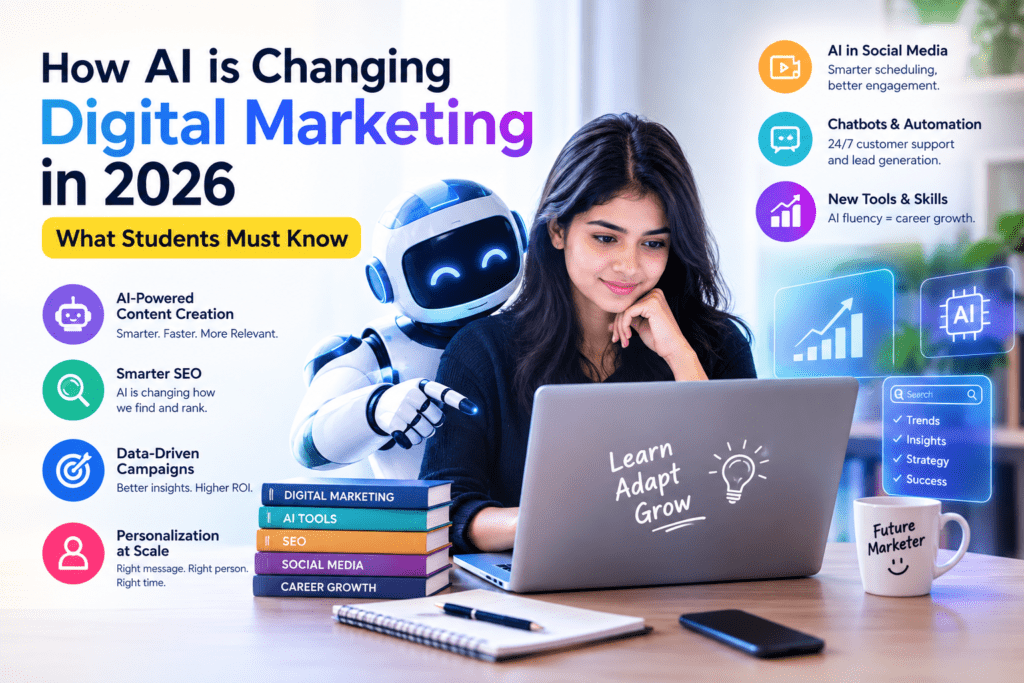
1. The Core Shifts: How AI is Reshaping Marketing
Digital marketing in 2026 relies on smart algorithms and machine learning to handle heavy lifting, allowing marketers to focus entirely on high-level strategy and creativity.
Hyper-Personalization at Scale: Consumers no longer tolerate generic emails or irrelevant ads. AI tracks real-time browsing history and purchase behavior to tailor content, product recommendations, and messaging instantly for every single user.
AI-Powered SEO & Search Intent: Traditional keyword stuffing is dead. Search engines now use advanced semantic search and AI models to evaluate user intent. SEO is now about matching the depth and relevance of answers rather than just tracking search volumes.
Smarter, Autonomous Advertising: Paid media campaigns on platforms like Google and Meta use AI to dynamically adjust bids, test creative variations, and shift budgets in real-time to maximize Return on Investment (ROI).
Predictive Analytics: Instead of reacting to past trends, AI models forecast future customer behavior, purchase intent, and market shifts before they happen.
2. What This Means for Marketing Students
If you are studying marketing, you might wonder: Is AI going to replace my future job?
The short answer is no, but marketers who use AI will replace those who do not. AI cannot replicate human emotion, brand empathy, or unique creative vision. However, it automates repetitive tasks, meaning the expectations for entry-level professionals have evolved.
Key Takeaway: Employers are no longer looking for people who can just write a basic social media caption or pull a routine report. They want professionals who know how to prompt AI, interpret analytics, and turn data outputs into creative campaigns.
3. Essential Skills Every Student Must Learn
To stand out in the 2026 job market, you need a blend of technical capability and traditional marketing foundations. Make sure your toolkit includes:
-
Prompt Engineering & Generative Tool Proficiency: Learn how to effectively utilize text, image, and video generation tools (like ChatGPT, Claude, and Gemini) to brainstorm, outline, and scale content production without losing brand voice.
-
Data Literacy: You don’t need to be a data scientist, but you must know how to read dashboards, analyze consumer metrics, and let data guide your choices rather than guesswork.
-
Prompt-Driven SEO & Content Strategy: Understand how AI assists with technical audits, competitor gap analysis, and intent mapping, while you inject the human storytelling element that algorithms cannot mimic.
-
Critical Thinking & Ethics: AI can occasionally produce biased or generic outputs. Knowing how to fact-check, edit for authenticity, and handle data privacy responsibly is a massive competitive advantage
Final Thoughts
The integration of AI into digital marketing represents a massive opportunity. For students willing to learn, adapt, and combine technical automation with creative strategy, the future is wide open. Start experimenting with AI marketing tools today, build a hands-on portfolio, and position yourself as a future-ready marketer.
Are you currently exploring any specific AI tools for your marketing projects or studies?