Entering the freelance market in India is an exciting step, but choosing where to hunt for your first clients can make or break your journey. With so many options available, three giants consistently dominate the conversation: Fiverr, Upwork, and LinkedIn.
Each platform operates on a completely different model. What works brilliantly for a web developer in Bengaluru might fail for a content writer in Kolkata.
This deep dive compares Fiverr, Upwork, and LinkedIn to help you decide which platform best suits your skill set, experience level, and career goals in the Indian freelance ecosystem.
1. Fiverr: The Inbound "Gig" Marketplace
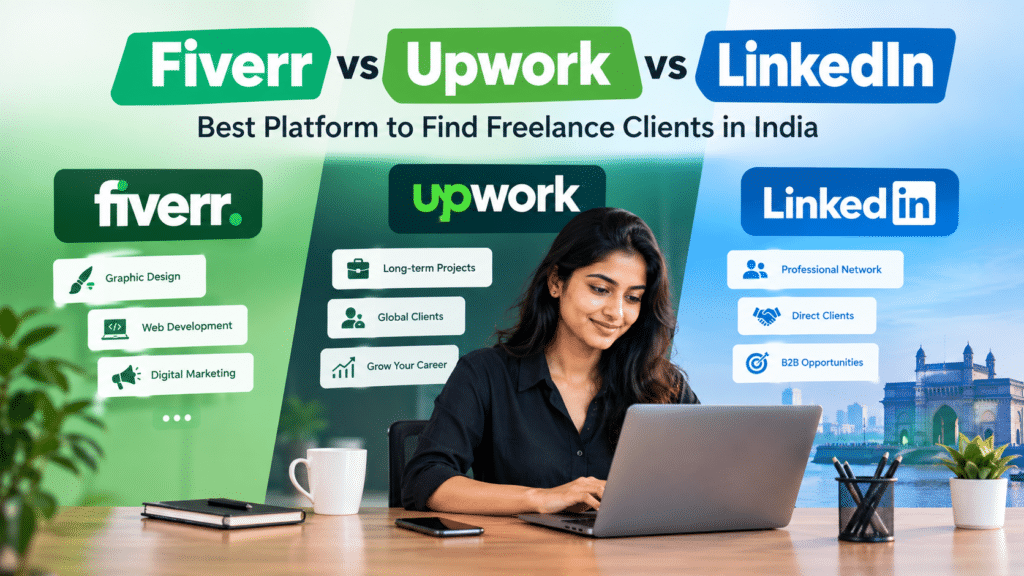
Fiverr is built around a catalog model. Instead of applying for jobs, you create predefined service packages called “Gigs” (e.g., “I will design a minimalist logo for $50”), and clients come to you.
How it works: Inbound. You set up your shop window, optimize it for search engines (SEO), and wait for buyers to purchase your packages.
Best for: Creative tasks with clear deliverables (graphic design, video editing, translation, voice-over, basic web development).
Pros for Indian Freelancers:
Passive discovery: Once your gig ranks well, clients can place orders while you sleep.
No “bid” costs: Unlike Upwork, you don’t have to pay to send proposals. Setting up gigs is free.
Clear scope: Because clients buy a predefined package, scope creep is easier to manage.
Cons:
Brutal competition: The marketplace is heavily saturated, making it difficult for beginners to stand out without existing reviews.
High platform fees: Fiverr takes a flat 20% commission on all your earnings.
Withdrawal hurdles: Direct bank integration can have nuances, often requiring third-party services like PayPal or Payoneer, which carry their own conversion and transfer fees.
2. Upwork: The Professional Outbound Bid Marketplace
Upwork functions more like a traditional digital job board combined with a contract marketplace. Clients post detailed project descriptions, and freelancers submit custom proposals using virtual currency called Connects.
How it works: Outbound. You browse the job feed daily, pitch customized proposals, and negotiate terms or hourly rates.
Best for: Professional, ongoing, and technical services (software engineering, complex digital marketing, data science, financial consulting, advanced copywriting).
Pros for Indian Freelancers:
Higher earning potential: Clients on Upwork generally have higher budgets and are looking for long-term partners rather than quick fixes.
Milestone and hourly protection: Upwork’s built-in escrow systems and time-trackers ensure you get paid securely for every hour worked.
Sliding fee scale: While it starts at 20% for new clients, the platform fee drops to 10% and eventually 5% as your billing history with a specific client grows.
Cons:
The “Connects” pay-to-play model: Applying for jobs costs Connects, meaning you have to spend real money just to pitch to clients, which can drain a beginner’s wallet.
Low initial visibility: New profiles struggle to land interviews because clients naturally favor freelancers with high Job Success Scores (JSS) and dozens of 5-star reviews.
3. LinkedIn: The Relationship & Networking Hub
LinkedIn is not technically a freelance marketplace—it is a professional social network. However, it has evolved into one of the most powerful tools for finding high-paying freelance clients directly.
How it works: Content marketing and direct outreach. You optimize your profile as a landing page, post valuable industry content, and pitch directly to founders, marketers, and decision-makers.
Best for: B2B services, consulting, ghostwriting, high-end strategy, and specialized tech roles.
Pros for Indian Freelancers:
Zero platform commissions: Whatever you charge and negotiate belongs entirely to you (minus standard bank/wire transfer fees).
Direct client access: You talk straight to the decision-maker without middlemen, corporate platform filters, or restrictive communication policies.
Higher trust and retainers: LinkedIn makes it much easier to build authentic personal authority, leading to lucrative monthly retainer contracts.
Cons:
Active daily effort required: It requires consistency—posting content, networking, and cold outreach. There is no automated algorithm handing you orders like Fiverr.
No built-in escrow: You have to manage your own contracts, invoicing, and advance payments (using tools like Razorpay, Wise, or Stripe) to protect yourself against ghosting.
Quick Comparison Table
| Feature | Fiverr | Upwork | |
| Primary Model | Inbound Gigs | Outbound Proposals | Networking & Outbound |
| Cost to Start | Free | Free to join (Pays for Connects) | Free |
| Platform Fee | Flat 20% | Sliding scale (20% to 5%) | 0% (Third-party gateway fees apply) |
| Competition | Extremely High (Global) | High (Varies by niche) | Moderate (Niche dependent) |
| Best For | Quick, packaged tasks | Structured mid-to-long projects | High-ticket retainers & B2B |
Which One Should You Choose? (The Verdict for India)
Choose Fiverr if: You want a low-maintenance setup, have a hyper-specific packaged skill (like video editing or logo design), and prefer clients coming to you while you focus purely on execution.
Choose Upwork if: You are ready to pitch actively, possess intermediate-to-advanced technical skills, and want a secure, milestone-driven environment to scale your freelance business.
Choose LinkedIn if: You want to escape heavy platform commissions, build a personal brand, and land high-paying monthly retainers directly from global or Indian startup founders.
Pro-Tip for Beginners: Don’t try to master all three at once. Pick one active platform (like LinkedIn or Upwork) to secure your primary income, and use Fiverr as a secondary storefront to catch passive orders and build early social proof.
What has your experience been like trying to land freelance clients in India? Which platform has brought you the best ROI? Drop a comment below!