Getting people to actually read your email newsletter requires a shift from sending generic broadcasts to delivering targeted, human-centric value. To break through the noise of a crowded inbox, start by segmenting your subscriber list so your messaging matches their exact stage or interests, and pair it with a concise, curiosity-driven subject line that avoids spammy clickbait. Inside the email, ditch the stiff corporate jargon and write in a conversational, first-person tone, using short paragraphs and bold text for easy skimming. Most importantly, follow the 80/20 rule—delivering 80% actionable insights, education, or entertainment before making any pitch—while optimizing your layout for mobile screens and ending with a prompt that encourages readers to hit reply.
Picture this: You spend hours drafting a newsletter. You agonize over every sentence, pick the perfect graphic, and hit “send” to your entire subscriber list. Then… crickets.
Low open rates, zero clicks, and an inbox full of unread messages.
If this scenario sounds painfully familiar, you aren’t alone. Inboxes are noisier than ever, and getting people to simply open your email is only half the battle. The real challenge is keeping their attention long enough to actually read, click, and care about what you have to say.
If you want to stop getting lost in the digital clutter, you need a strategy shift. Here is how to transform your newsletter from an easily ignored broadcast into an eagerly awaited inbox event.
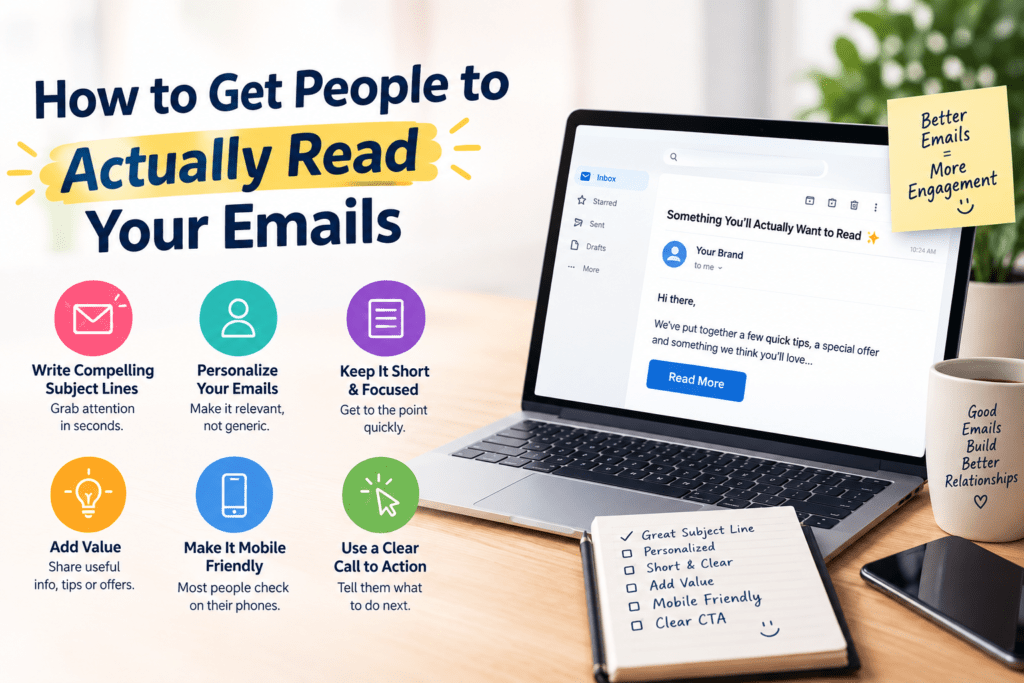
1. Ditch the Broadcast Mentality and Segment Your List
The fastest way to get ignored is to send the exact same generic message to every single person on your list. A subscriber who just bought a product has entirely different needs than someone who signed up via a lead magnet yesterday.
Use dynamic segmentation: Break your list down based on user behavior, past purchases, interests, or engagement levels.
Tailor your messaging: When an email feels like it was written specifically for the reader’s current situation, reading it stops being a chore and starts being a priority.
2. Master the Art of the Subject Line (Without Resorting to Clickbait)
Your subject line is the gatekeeper. If it fails, your content never sees the light of day. However, relying on misleading, spammy clickbait (“You won’t believe what happened!”) might win you an open, but it destroys trust when the reader realizes the email has zero substance.
Keep it concise and punchy: Aim for under 50 characters so it doesn’t get cut off on mobile screens.
Spark genuine curiosity or utility: Use open loops, pose a direct question, or highlight an immediate benefit (e.g., “The 3-step checklist for fixing your mobile layout” or “Why your local SEO strategy is leaking traffic”).
Test what works: Regularly A/B test different subject line angles—like a straightforward benefit versus a casual question—to see what your specific audience responds to.
3. Write Like a Human (Drop the Corporate Jargon)
Nobody wakes up in the morning excited to read a corporate press release disguised as a newsletter. If your copy sounds like a robot wrote it, your readers will tune out instantly.
Write in the first person: Use “I” and “you.” Make it feel like a 1-on-1 conversation sitting across a coffee table.
Show some personality: Inject your brand’s actual voice, share behind-the-scenes hurdles, or talk about a mistake you made and what you learned. Authenticity beats corporate polish every single time.
Format for the “squint test”: People don’t read emails; they scan them. Break up dense walls of text with short paragraphs, bold text for key takeaways, and plenty of white space.
4. Prioritize Value Over Promotion
If every single email you send is a pitch to buy something, sign up for a service, or register for an event, subscribers will start hitting unsubscribe.
The 80/20 Rule: Aim to give away 80% pure, actionable value—education, entertainment, or insights—and only 20% direct promotion.
Solve a specific problem: Give readers a quick win they can implement immediately. When people know your newsletter consistently teaches them something useful, they will actively search for your name in their inbox next time.
5. Optimize for Mobile (Or Lose Half Your Readers)
Over half of your audience is likely opening your newsletter on a smartphone while waiting in line or commuting. If your formatting breaks on mobile, they aren’t going to save it for desktop—they are just going to delete it.
Keep your design clean: Single-column layouts perform best on mobile screens.
Make links thumb-friendly: Ensure your Call-to-Action (CTA) buttons are large and easy to tap without accidentally clicking the wrong link.
Check the dark mode contrast: Many users view their inboxes in dark mode. Make sure your text colors and transparent background images don’t blend invisibly into a dark screen
6. Encourage Two-Way Interaction
An email newsletter shouldn’t be a one-way megaphone. When your email service provider sees that people are actually replying to your emails, it signals to inbox providers (like Gmail) that you belong in the Primary tab, not the Promotions folder.
Ask a direct question: End your newsletter by asking readers a simple question and telling them to hit reply. (e.g., “What is the biggest roadblock you’re facing with your ad campaigns this week? Hit reply and let me know—I read every response.”)
Add interactive elements: Incorporate a quick one-question poll, a rating scale, or a feedback link directly inside the email. It lowers the friction to engage and makes the reader feel like a participant rather than a passive target.
Final Thoughts: Consistency Is Your Ultimate Weapon
The biggest killer of email engagement is an unpredictable schedule. If you email your list three times in one week and then disappear for two months, you train your audience to forget who you are.
Pick a realistic cadence—whether that’s every Tuesday morning or bi-weekly on Thursday—and stick to it religiously. Pair that consistency with targeted segments, human-first storytelling, and undeniable value, and you won’t just get people to open your emails—they’ll start looking forward to them.
What is the biggest challenge you currently face when trying to get engagement on your email campaigns?