Staring at a blank document while trying to squeeze a high-converting message into a strict character limit is a universal marketer’s dilemma. Between brainstorming hooks, drafting body copy, and tailoring variations for Facebook, Google, or LinkedIn, ad creation can easily consume entire afternoons.
Enter artificial intelligence. When used correctly, AI shifts from being a generic text generator to a high-speed force multiplier. It doesn’t replace human strategy—instead, it handles the heavy lifting of volume and variation, cutting your ad creation time in half.
Why Generic AI Prompts Fail (And How to Fix Them)
If you’ve ever typed “Write a Facebook ad for my eco-friendly water bottle” into an AI tool and received bland, robotic “AI slop,” you aren’t alone. Vague prompts yield vague copy.
To get high-performing ad text, treat AI like a junior copywriter who needs a thorough onboarding:
Build a Brand Intelligence Document: Feed your AI core details about your brand voice, target demographic, unique selling propositions (USPs), and customer pain points before asking it to write a single line.
Provide Context and Constraints: Specify the platform, target word count, and exact tone (e.g., “Write a casual, punchy 3-sentence Facebook primary text targeting busy moms”).
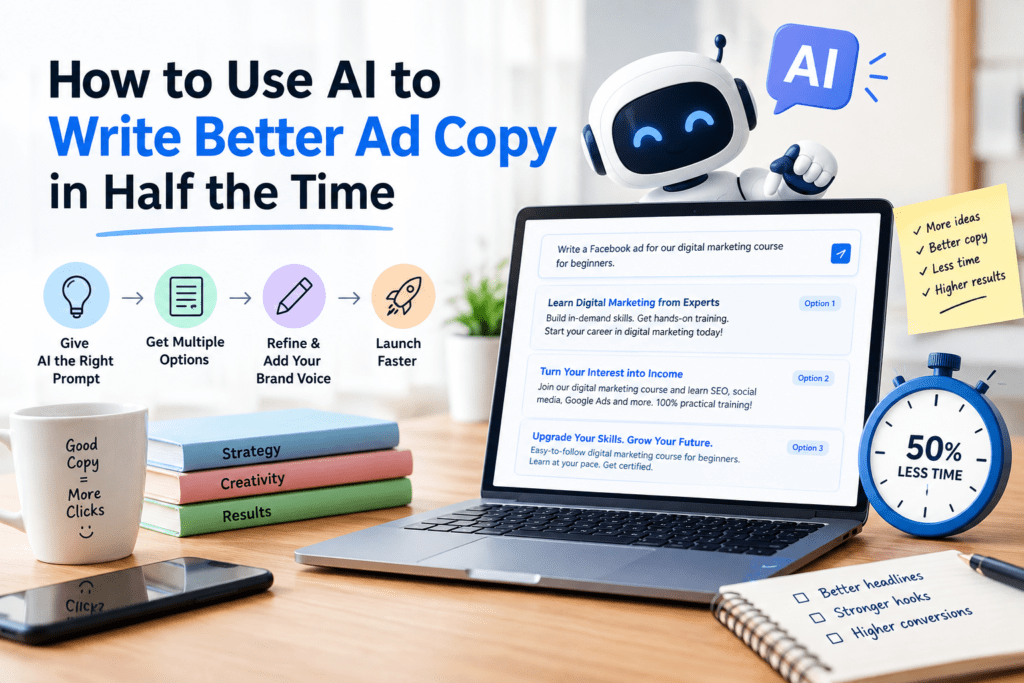
A 4-Step Framework for AI-Powered Ad Creation
1. Generate High-Converting Hooks
The first three seconds dictate whether an ad lives or dies. Use AI to rapidly brainstorm diverse psychological angles—such as curiosity loops, direct pain points, or bold pattern interrupts.
Prompt Example: “Give me 5 distinct ad hooks for an online productivity planner targeting burnt-out remote workers. Use different angles: one curiosity-driven, one data-backed, and one direct callout.”
2. Focus on Mechanisms and Transformation
Great ad copy focuses less on features and more on the transformation the customer experiences. Ask AI to draft body copy that addresses specific customer objections and highlights the unique mechanism behind your product.
Human role: Inject authentic customer reviews, real case studies, or brand stories into the AI’s draft to maintain emotional resonance.
3. Build Headlines and Descriptions at Scale
Different placements require different formats—from short search headlines to long-form social descriptions. AI excels at repurposing a single core message into dozens of tailored variations instantly.
Make sure your primary keywords are naturally woven into search ad headlines to maintain relevance and quality scores.
4. Optimize Your Call-to-Action (CTA)
A strong CTA tells the user exactly what to do next while crushing lingering hesitation. Use AI to test different psychological triggers, combining a clear action with an objection crusher (e.g., “Claim Your Free Trial — No Credit Card Required”).
Best Practices: Keeping the Human Touch
AI is an incredible volume producer, but humans are the ultimate editors and strategists. Keep these guardrails in mind:
Fact-Check Everything: AI tools are prone to hallucinating product specs, discounts, or delivery timelines.
Prioritize A/B Testing: Leverage AI’s speed to generate multiple variations, then let live campaign data decide which messaging actually resonates with your audience.
Inject Empathy: Software can replicate tone, but lived human experience builds true brand connection.
By letting AI handle the structural groundwork and rapid iteration, you free up mental bandwidth to focus on what truly matters: high-level strategy, creative direction, and tracking your ROI.
What is your biggest bottleneck when writing ad campaigns—finding the right hook, or scaling variations across platforms? Let’s chat in the comments below!