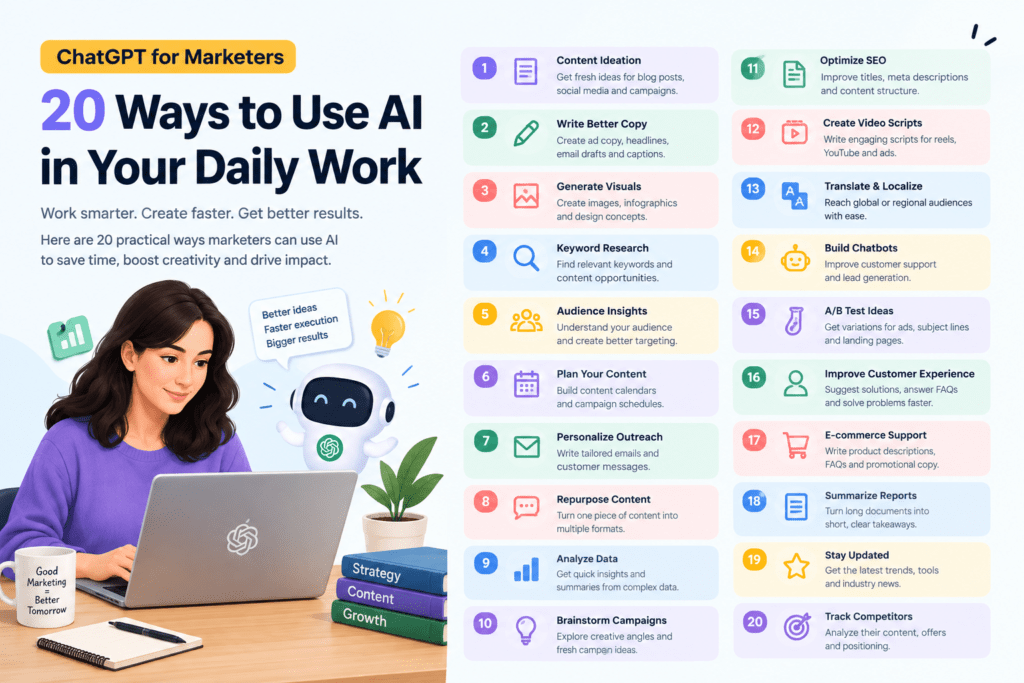
Artificial Intelligence has shifted from a futuristic buzzword to a non-negotiable daily driver for modern marketing teams. Among the myriad of tools available, ChatGPT has emerged as an indispensable co-pilot, helping professionals reclaim hours of manual labor, spark creative breakthroughs, and execute campaigns with precision.
Whether you are a solo entrepreneur, an agency freelancer, or part of an enterprise marketing team, here are 20 practical ways you can harness ChatGPT to supercharge your daily workflow.
Part 1: Content Creation & Copywriting
Content is still king, but the timeline from ideation to publication has shrunk drastically thanks to AI.
1. Generating High-Converting Ad Copy
Struggling to write compelling hooks for Facebook, Instagram, or Google Ads? Feed ChatGPT your product details, target audience, and unique selling proposition (USP) to instantly output multiple variations tailored to different angles (e.g., pain-point-driven vs. benefit-driven).
2. Drafting Blog Outlines and Long-Form Content
Never stare at a blank page again. Use ChatGPT to outline structured, SEO-friendly headers for your blog posts, expand bullet points into cohesive paragraphs, or draft initial long-form drafts that you can polish with your brand’s unique voice.

3. Crafting Engaging Social Media Captions
Repurpose a single piece of content across platforms. Ask ChatGPT to transform a corporate press release into a witty, emoji-laden Twitter/X thread, a thought-leadership LinkedIn post, or an engaging Instagram caption complete with relevant hashtags.
4. Rewriting Content for Different Tones
Have a technical product description that sounds too dry? Prompt ChatGPT to rewrite it to sound conversational, persuasive, urgent, or humorous, matching your precise brand persona guidelines.
5. Writing and Refining Email Subject Lines
Your open rates depend heavily on your subject lines. Have ChatGPT generate 20 distinct subject-line options based on curiosity gaps, urgency, personalization, or direct benefits—and test them against each other.
Part 2: Strategy & Ideation
When you find yourself stuck in a creative rut, ChatGPT acts as an objective, tireless brainstorming partner.
6. Brainstorming Campaign Concepts
Kick off your next big product launch or seasonal campaign by asking ChatGPT for out-of-the-box creative concepts, multi-channel rollout ideas, and experiential marketing hooks.
7. Conducting Persona Development
Build detailed buyer personas by prompting ChatGPT with basic demographics. Ask it to outline their daily frustrations, purchasing triggers, preferred media channels, and common objections to help tailor your messaging.
8. Mapping Out Content Calendars
Plan an entire month of content in minutes. Ask the AI to build a strategic editorial calendar mapping out blog themes, email blasts, and social media schedules customized to your niche and business goals.
9. Finding Niche Keywords and Content Clusters
While it doesn’t replace heavy-duty SEO tools entirely, ChatGPT is exceptional at brainstorming long-tail keyword variations, semantic subtopics, and content cluster ideas to improve topical authority.
10. Competitor Analysis Frameworks
Input a brief description of your top competitors and ask ChatGPT to help you build a SWOT analysis (Strengths, Weaknesses, Opportunities, Threats) or identify gaps in their marketing strategies that you can exploit.
Part 3: Data Analysis & Research
Marketers deal with endless text data, feedback, and metrics. ChatGPT helps distill raw data into actionable insights.
11. Analyzing Customer Feedback and Reviews
Paste a batch of customer reviews, app store feedback, or survey responses into ChatGPT and ask it to perform a sentiment analysis, highlighting the top three pain points customers complain about most frequently.
12. Summarizing Long Reports and PDFs
Drop lengthy industry reports, whitepapers, or case studies into the chat and ask for a concise bulleted summary of key statistics, takeaways, and actionable trends.
13. Organizing Unstructured Data
Have a messy list of raw notes, unstructured feedback, or product attributes? Ask ChatGPT to clean, categorize, and format the data neatly into a structured markdown table or CSV format.
14. Creating Survey and Questionnaire Questions
Design airtight market research surveys. Prompt ChatGPT to draft quantitative rating-scale questions or qualitative open-ended prompts designed to extract unbiased customer insights.
15. Formulating A/B Testing Hypotheses
Stuck on what to test next on your landing pages? Ask ChatGPT to review your page elements and suggest data-backed A/B testing hypotheses focusing on headline clarity, CTA placement, or trust signals.
Part 4: Workflow Automation & Optimization
Streamline the tedious administrative aspects of marketing operations to focus on strategy.
16. Building Multi-Step Email Sequences
Draft automated lifecycle workflows—such as a 5-part welcome series, an abandoned cart recovery sequence, or a customer win-back campaign—complete with strategic email delays and tailored messaging.
17. Writing Technical Briefs for Designers or Developers
Translate marketing requests into clear, concise creative briefs. Have ChatGPT write precise instructions for web developers (e.g., tracking pixel implementation guidelines) or graphic designers (visual asset requirements).
18. Translating and Localizing Copy
Expand into international markets by asking ChatGPT to translate your marketing assets while adapting idioms, cultural nuances, and localized phrasing to fit target regions naturally.
19. Generating FAQs and Knowledge Base Articles
Analyze your product features or customer service logs to build comprehensive FAQ sections that address common objections, reducing friction in the buyer’s journey.
20. Code Assistance (HTML/CSS/Regex)
Need to quickly style a landing page component, write a regular expression (Regex) for your Google Analytics tracking, or format a basic email HTML snippet? ChatGPT can write and troubleshoot basic code snippets instantly.
Final Thoughts: The Human Advantage
ChatGPT is a powerful lever, but it is a co-pilot, not the driver. The most successful marketers use AI to accelerate execution, eliminate grunt work, and fuel ideation—leaving the final layer of brand empathy, strategic oversight, and creative brilliance firmly in human hands.