For years, digital marketers and business owners treated email as the undisputed king of direct communication. It was formal, structured, and scaled effortlessly. However, the marketing landscape—especially in mobile-first markets like India—has undergone a massive transformation.
With over half a billion active users treating WhatsApp as their primary digital lifeline, a new contender has captured the spotlight.
If you are a business owner or marketer trying to allocate your budget, you are likely facing the ultimate modern dilemma: Should you invest in WhatsApp marketing, or stick to tried-and-true email marketing?
Let’s break down how both channels stack up in the Indian market, analyze their core metrics, and discover how to make them work together.
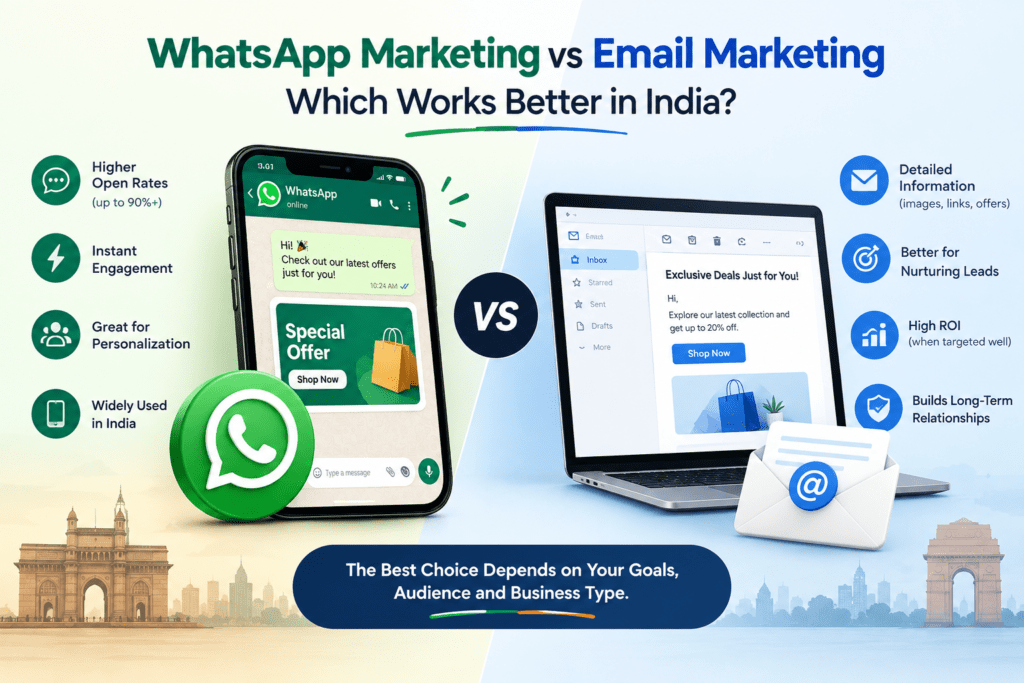
1. The Indian Context: Why WhatsApp Rules the Pocket
In India, WhatsApp is much more than a messaging app; it is an operating system for daily life. From chatting with family and ordering groceries to paying local vendors via UPI, Indians live on WhatsApp.
Because consumers check WhatsApp dozens of times a day, marketing messages sent via the WhatsApp Business API land right where attention is highest. Conversely, promotional emails in India often land in cluttered Gmail “Promotions” tabs, remaining unread for days—or getting deleted unread.
2. Head-to-Head Metric Comparison
| Metric | WhatsApp Marketing | Email Marketing |
| Open Rate | 95% – 98% | 20% – 25% |
| Click-Through Rate (CTR) | 45% – 60% | 2% – 5% |
| Response Time | Minutes | Hours or Days |
| Cost Per Message | Higher (Via WhatsApp Business API) | Extremely Low |
| Format & Content | Short, punchy, rich media, interactive buttons | Long-form, newsletters, detailed graphics |
3. Where WhatsApp Marketing Wins in India
Astounding Open and Engagement Rates
It’s hard to ignore a 98% open rate. When a WhatsApp notification pops up, it creates an immediate sense of urgency. Combined with interactive call-to-action (CTA) buttons (like “Claim Offer” or “Track Order”), WhatsApp achieves click-through rates that email simply cannot match.
High-Converting Use Cases
WhatsApp excels at immediate, transactional, and high-intent touchpoints:
Abandoned Cart Recovery: Sending a quick reminder with a direct checkout link.
Time-Sensitive Offers: Flash sales, festival discounts (Diwali, Eid, Independence Day), and limited-time coupons.
Transactional Alerts: Real-time shipping updates, booking confirmations, and appointment reminders.
Customer Support: Resolving grievances through conversational chatbots or live agents instantly.
4. Where Email Marketing Still Holds the Crown
While WhatsApp dominates speed and attention, email remains an essential tool for specific business requirements:
Cost-Effective Scaling
While WhatsApp Business API conversations carry a per-message fee set by Meta, email marketing platforms allow you to blast tens of thousands of emails for a fraction of the cost.
Long-Form Content and Nurturing
If you need to share a detailed company newsletter, a comprehensive product guide, a case study, or corporate compliance documents, email is the professional choice. Its structured HTML layout provides ample space for storytelling without overwhelming the recipient.
B2B and Formal Communication
For business-to-business (B2B) pitches, institutional onboarding, and formal proposals, email remains the culturally expected medium. Pitching a corporate client via an unprompted WhatsApp message can sometimes cross privacy boundaries, whereas email feels safe and professional.
5. The Verdict: Which Works Better in India?
For sheer conversion speed, engagement, and ROI on promotional campaigns, WhatsApp wins hands down in India. Indian consumers prefer conversational, friction-free interactions over digging through an inbox.
However, looking at it as a “this vs. that” battle is a mistake. The highest-performing Indian brands use a hybrid strategy:
Use Email to build long-term brand awareness, distribute educational content, and handle formal documentation.
Use WhatsApp to trigger instant alerts, close sales, handle customer service, and drive flash-sale conversions.