The Ultimate Guide to Writing Email Subject Lines That Get Opened (With Examples)
Your email could contain the greatest offer, the most insightful advice, or the most breathtaking discount of the year. But if your subject line fails, none of that matters.
In the hyper-crowded inbox of the modern consumer and business professional, the subject line is the gatekeeper. It is the single deciding factor between your message being eagerly read or mercilessly swiped into the trash folder. With the average person receiving over one hundred emails a day, attention is the scarcest commodity on the internet.
If you want to boost your open rates, improve campaign ROI, and ensure your message cuts through the digital noise, you need to master the art and science of the email subject line. This comprehensive guide explores the psychology of opens, proven formulas, real-world examples, and best practices to transform your email marketing results.
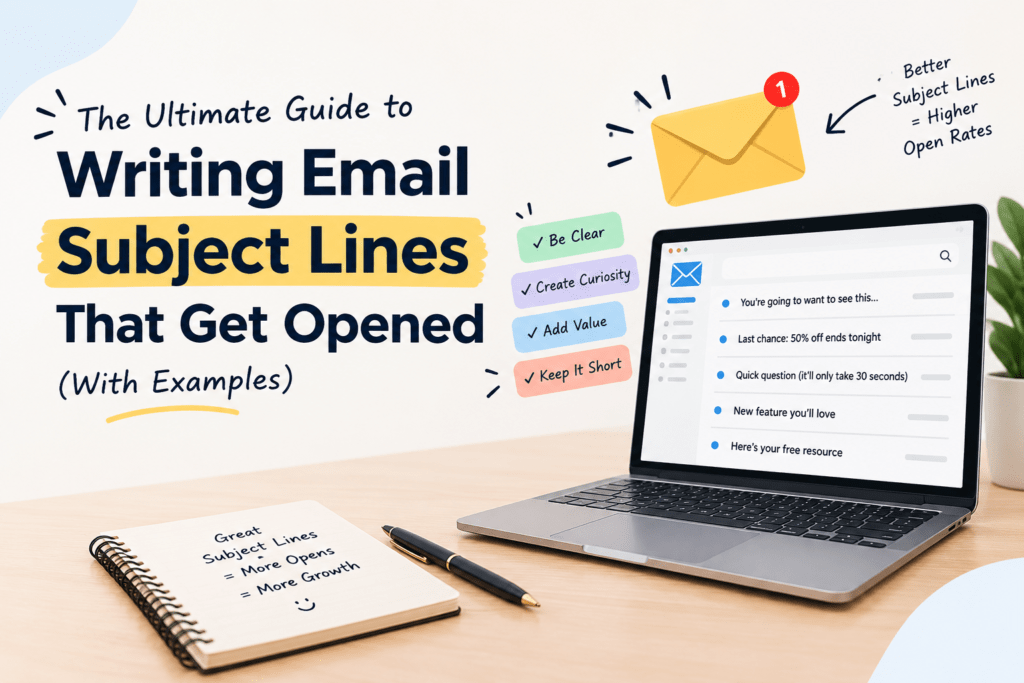
1. Why Email Subject Lines Matter More Than Ever
Think of your subject line as a movie trailer. Its sole purpose is to convince the audience to invest their time in the main event.
Studies show that nearly 47% of email recipients open an email based on the subject line alone, while 69% report emails as spam strictly based on a misleading or unappealing subject line.
When crafting a campaign, marketers often spend hours perfecting the body copy while treating the subject line as an afterthought—a quick summary tossed in at the last minute. This backwards approach caps your performance before your email even launches. Shifting your focus to the subject line ensures your foundational hook matches the value waiting inside.
With billions of emails sent daily, inboxes are more competitive than ever. A great subject line acts as a value proposition in miniature. It sets expectations, builds anticipation, and establishes trust.
-
The First Impression: It is often the only text a subscriber sees before deciding whether to read, delete, or mark your message as spam.
-
The Open Rate Driver: Optimizing your subject line is the single fastest way to lift overall campaign performance without rewriting your core content.
-
Mobile Dominance: Over half of all emails are opened on mobile devices, where truncation cuts long subject lines short (typically around 35 to 50 characters).
2. Core Psychology Triggers That Drive High Opens
Understanding human behavior is the secret weapon of top-tier copywriters. When you tap into these psychological triggers, opening your email becomes an instinctual response:
Curiosity: Leaving a compelling information gap makes the reader feel they need to open the email to complete the picture.
Urgency & Scarcity: Fear of Missing Out (FOMO) creates immediate action by attaching a time limit or limited quantity to an offer.
Personalization: Seeing a name, location, or tailored reference signals that the message is relevant, not generic blastware.
Utility & Value: Clearly stating an immediate, tangible benefit gives subscribers an undeniable reason to click.
3. High-Converting Subject Line Formulas & Examples
A. The Curiosity Gap
Formula: Hint at something valuable without giving away the punchline.
Examples:
“The one marketing metric you’re probably ignoring…”
“We tried this weird strategy for 30 days. Here’s what happened.”
“Are you making this costly mistake on your landing page?”
B. Urgency and Scarcity
Formula: Combine a deadline or limit with an irresistible hook.
Examples:
“⏳ 24 hours left: Claim your early-bird registration!”
“Selling out fast: Our newest collection is almost gone.”
“Last chance to grab the Q3 Growth Blueprint.”
C. Direct and Benefit-Driven
Formula: Tell them precisely what they get, zero fluff.
Examples:
“Double your open rates with these 3 quick fixes.”
“Free Checklist: Your 10-step local SEO audit.”
“How to cut your ad spend without losing leads.”
D. Question-Based
Formula: Ask a burning question your target audience relates to.
Examples:
“Struggling with low website traffic?”
“Ready to scale your agency to 6 figures?”
“Is your email list making you money?”
4. Best Practices for Maximizing Your Open Rates
To ensure your subject lines consistently perform well, keep these tactical rules in mind:
Keep it Concise: Aim for 35 to 50 characters so your text displays fully on mobile screens.
Mind the Preheader: Use the preview text (preheader) as an extension of your subject line to add context or amplify curiosity.
A/B Test Relentlessly: Test different angles—such as a question versus a direct statement—to see what resonates best with your specific audience.
Avoid Spam Trigger Words: Steer clear of all-caps, excessive punctuation (like multiple exclamation marks), and overly salesy words like “GUARANTEED” or “FREE $$$” that land you in the promotions or spam tab.
5. Summary Checklist for Your Next Campaign
Before you hit send on your next email broadcast, run your subject line through this quick filter:
Is it clear and easy to read in under 3 seconds?
Does it create genuine curiosity, urgency, or clear value?
Is it optimized for mobile devices (short length)?
Does it avoid spammy formatting and language?
Mastering the art of the subject line takes experimentation, but by focusing on human psychology and clear value, you will steadily watch your open rates climb.