Every year, digital marketers predict the “death of email.” Critics point to the rise of short-form video algorithms, hyper-targeted social media ads, and conversational AI search tools, arguing that the traditional inbox has lost its appeal.
Yet, as we navigate through 2026, the data tells a radically different story. Email marketing continues to wear the crown as the undisputed king of digital marketing return on investment (ROI).
So, why does email keep winning, how has it evolved, and is it still the highest-yielding channel for businesses today? Let’s dive in.
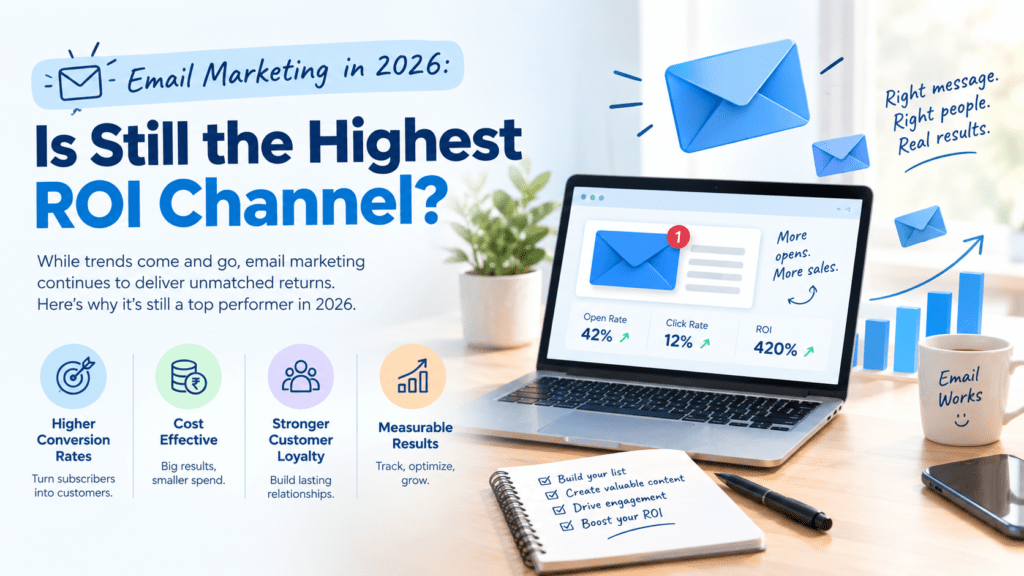
The Numbers Speak: Does Email Still Deliver?
Yes. In fact, its performance remains unmatched. Industry benchmarks consistently show that email marketing delivers an average return of $36 to $42 for every $1 spent. To put that in perspective, that dwarfs the average returns of paid search and social media advertising.
Why does this massive gap persist?
The Power of Intent: People on your email list are not random scrollers on a social media feed. They have actively chosen to give you their email address. They already know, like, and trust your brand.
Rented Land vs. Owned Media: Social media algorithms change overnight, cutting organic reach to a fraction of your follower base. Your email list is owned media—you control the audience, the message, and the timing without an algorithm gatekeeping your reach.
What Changed? Email Marketing in 2026
1. AI-Powered Hyper-Personalization at Scale
Gone are the days of basic segmentation like adding a subscriber’s first name to a generic newsletter. In 2026, AI algorithms analyze real-time browsing behavior, past purchases, predictive lifetime value, and engagement patterns.
Every recipient receives dynamically changing content blocks tailored to their personal preferences.
Send times are optimized using predictive analytics for each individual subscriber, maximizing the chance of immediate engagement.
2. Omnichannel Integration
Email no longer operates in a vacuum. Modern marketing stacks seamlessly sync email with SMS, push notifications, and social retargeting. Email acts as the anchor of complex customer journey maps—triggering follow-up texts or ad variations based on whether a user opened, clicked, or ignored a specific email.
3. The Shift to “Value-First” and Deliverability Security
With major inbox providers (like Google and Yahoo) strictly enforcing authentication protocols (SPF, DKIM, DMARC), spam filters are harsher than ever. Brands can no longer blast low-quality lists and hope for the best. Success in 2026 requires clean lists, strict opt-in compliance, and content that genuinely leads with utility, education, or targeted solutions rather than aggressive sales pitches.
The Automation Advantage: Working Smarter
One-off broadcast newsletters are important for announcements, but automated workflows are where the real profit lives. Automated sequences—such as welcome series, abandoned cart reminders, and win-back campaigns—generate exponentially higher returns because they hit users right when intent is highest.
Once built, these systems run quietly in the background, nurturing leads and closing sales 24/7.
The Verdict: Is Email Still the King?
Absolutely. While newer channels excel at top-of-funnel brand awareness, email remains the ultimate medium for conversion, retention, and monetization. It gives businesses stability against platform volatility, protection against rising ad costs, and a direct line to the most valuable asset a company can own: a permission-based audience.
If your email marketing strategy still feels like a basic monthly blast, you are only scratching the surface of what the channel can do. In 2026, treating email as a dynamic, AI-driven, and automated experience is the fastest way to bulletproof your marketing budget.
Key Takeaway: Stop chasing every shiny new algorithm and start doubling down on the asset you actually own. Your inbox is your highest-yielding storefront.