If you have ever dipped your toes into the vast ocean of digital marketing, freelancing, or content creation, you have undoubtedly encountered two terms used interchangeably by the uninformed: copywriting and content writing.
To the outsider, they sound identical. Both involve sitting in front of a keyboard, stringing words together, and publishing them on the internet. But ask any seasoned marketer, and they will tell you that comparing copywriting to content writing is like comparing a high-stakes sales pitch to an engaging documentary. They serve entirely different purposes, require distinct psychological skill sets, and—crucially for many writers—command vastly different pay scales.
Whether you are an aspiring writer trying to carve out a profitable niche, a business owner looking to hire the right talent, or simply a curious wordsmith, understanding the nuances between these two disciplines is essential.
Defining the Contenders
To understand where they diverge, we must first look at what each discipline sets out to achieve.
What is Copywriting?
At its core, copywriting is the art and science of writing persuasive text (known as “copy”) that prompts people to take a specific action.
Copywriting is the digital equivalent of a high-performing salesperson. Every single word, sentence, and button label is meticulously engineered to guide the reader down a psychological funnel. The ultimate goal is transaction or conversion—whether that means buying a product, signing up for a newsletter, booking a consultation, or downloading an app.
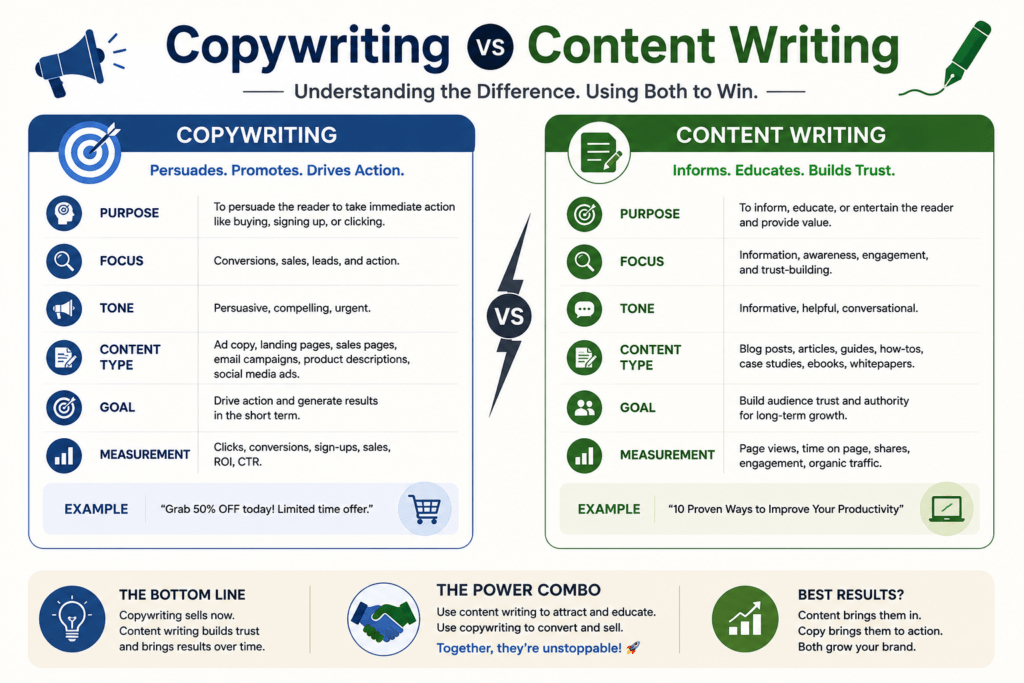
Primary Objective: Conversion and action.
Tone: Persuasive, urgent, emotion-driven, and benefit-focused.
Common Formats: Landing pages, sales letters, Google and social media ads, email marketing sequences, product descriptions, and video sales letter scripts.
What is Content Writing?
Content writing is the process of creating valuable, educational, or entertaining material designed to attract, engage, and retain an audience.
Unlike copywriting, content writing doesn’t immediately ask the reader to pull out their credit card. Instead, it plays the long game. It builds brand awareness, establishes authority, fosters trust, and provides genuine utility. By answering questions and solving problems, content writers create a loyal audience that eventually turns into paying customers organically over time.
Primary Objective: Engagement, education, and brand trust.
Tone: Informative, objective, conversational, and authoritative.
Common Formats: Long-form blog posts, white papers, e-books, case studies, social media articles, and how-to guides.
Core Differences at a Glance
| Feature | Copywriting | Content Writing |
| Main Goal | Drive immediate action/conversion | Educate, entertain, and build trust |
| Timeframe | Short-term impact (immediate results) | Long-term impact (SEO, ongoing traffic) |
| Focus | Emotions, pain points, and desires | Information, data, utility, and search intent |
| Length | Typically short (ads, landing pages) | Typically long (blogs, guides, white papers) |
| Success Metric | Click-through rates, conversions, ROI | Traffic, backlinks, time on page, shares |
The Psychology Behind the Words
The fundamental difference between these two forms of writing lies in human psychology. Why do people read copy, and why do they read content?
The Copywriting Mindset: Emotion and Urgency
The fundamental difference between these two forms of writing lies in human psychology. Why do people read copy, and why do they read content?
Copywriting relies heavily on the AIDA framework:
Attention: Hook the reader immediately with a powerful headline.
Interest: Keep them reading by addressing their specific problem.
Desire: Show them how your product or service is the ultimate solution.
Action: Direct them clearly on what to do next (the Call to Action).
The Content Writing Mindset: Value and Authority
Content writing, on the other hand, operates on the principle of generosity and reciprocity. Readers turn to content writing when they are searching for answers (e.g., “How to fix a leaky faucet” or “What is B2B SaaS marketing?”).
A great content writer acts as a trusted guide. They must master search engine optimization (SEO), structuring data, conducting thorough research, and presenting complex concepts in an easily digestible, engaging format. While content writing may eventually lead to a call-to-action, its primary currency is trust, not an immediate transaction.
Which Pays More? (The Million-Dollar Question)
Let’s address the elephant in the room. If you are choosing a career path or pricing your freelance services, financial viability matters.
Generally speaking, copywriting pays significantly more per project or per hour than content writing. However, the reality is nuanced, and the highest-earning writers often blend elements of both.
Why Copywriting Commands Higher Rates
Direct Tie to Revenue: Copywriters can draw a direct line between their words and the client’s bank account. If an email sequence generates $50,000 in sales, a $3,000 fee for writing that sequence feels like a bargain to the business owner. Copywriting is viewed as an investment with a measurable Return on Investment (ROI); content writing is often viewed as a marketing expense.
Lower Word Count, Higher Value: A copywriter might spend three days researching, strategizing, and writing a single 300-word landing page—and charge $1,500 for it. A content writer might write a 2,000-word blog post for $300 in the same amount of time. Clients often struggle to pay high rates for high word counts when they see low word counts bringing in massive revenue.
Niche Expertise: Copywriters must deeply understand direct-response marketing, consumer psychology, conversion rate optimization (CRO), and split testing. This specialized skill set is rarer and harder to master.
The Content Writing Earning Potential
While general blog writing for content mills pays very poorly ($0.02 to $0.05 per word), elite content writers working in specialized niches can earn six figures easily. High-paying content writing opportunities include:
Technical B2B Writing: Explaining complex software, cybersecurity, or fintech products.
White Papers and Case Studies: In-depth industry reports that enterprise companies use to close major deals.
Medical and Financial Writing: Topics that require strict regulatory compliance, accurate research, and certified expertise.
Can You Do Both? (The Hybrid Writer)
The most successful modern freelance writers do not box themselves into a single category. They are hybrid writers.
A modern brand needs both disciplines to survive. They need content writers to drive organic traffic via Google search and establish industry thought leadership. But once those readers land on the website, they need a copywriter to convert those casual visitors into paying customers.
If you can write SEO-optimized blog posts that gracefully transition into a persuasive pitch, you possess a rare and lucrative superpower.
Summary: Which Path Should You Choose?
Choose Copywriting if: You love psychology, enjoy studying marketing funnels, prefer working on short-form projects, and want to tie your income directly to sales and revenue generation.
Choose Content Writing if: You love research, enjoy storytelling, excel at explaining complex topics, and prefer the steady, long-term rhythm of building organic search traffic and brand communities.
Ultimately, words are the most powerful tool in business. Whether you choose to persuade through high-converting copy or educate through compelling content, mastering the craft of strategic writing will always be a high-income skill in the digital age.
Author’s Note: If you are building out digital assets for your brand, remember that balance is key. Use content to invite people through the front door, and use copy to close the sale once they are inside.