The catch-22 of entering the digital marketing industry is frustratingly familiar: employers want experience, but you need a job to get experience.
If you are a fresh graduate, career-switcher, or self-taught enthusiast staring at a blank resume, the solution isn’t to wait around for someone to give you a chance. The solution is to build evidence.
In digital marketing, what you can do matters far more than where you studied. A stellar portfolio acts as undeniable proof of your skills, turning “I know theory” into “Here is what I can actually execute.”
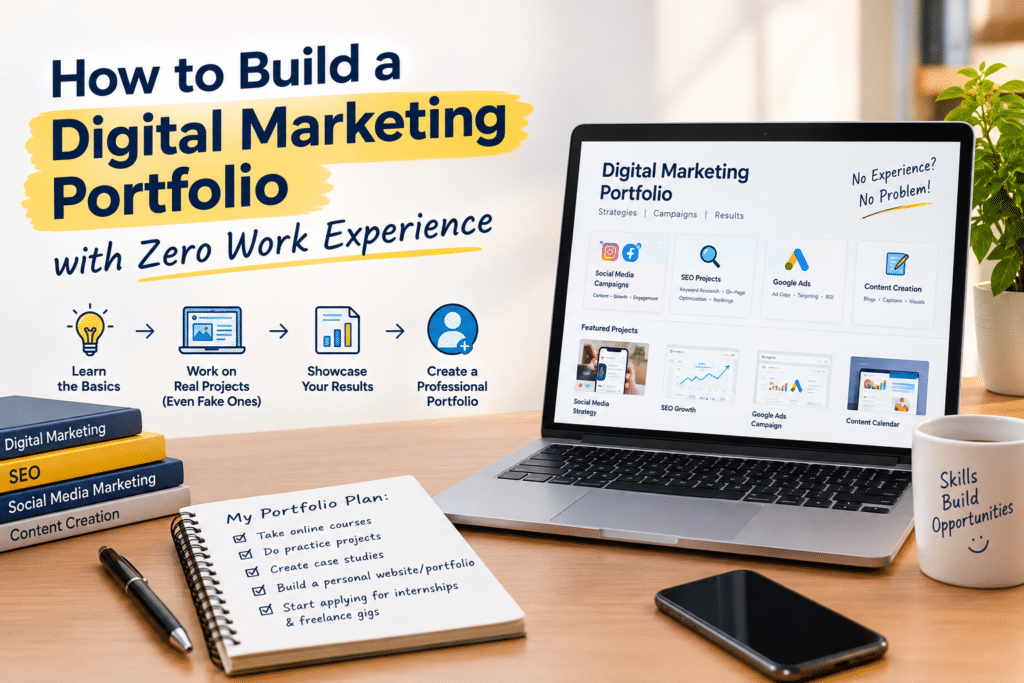
Here is a step-by-step guide to building a winning digital marketing portfolio completely from scratch.
1. Pick Your Specialization (Focus Areas)
Digital marketing is massive—encompassing SEO, paid ads, social media, content marketing, and email automation. Trying to master everything at once will dilute your portfolio.
Pick two core areas that align with the jobs you want to target (e.g., SEO + Content, or Social Media + Paid Ads). This gives your portfolio focus and shows depth rather than superficial knowledge.
2. Create Self-Initiated "Real-World" Projects
No client? No problem. You can treat hypothetical businesses like real clients. Choose a local business (like a neighborhood café, boutique, or gym) or invent a mock brand and build complete campaigns from scratch:
For SEO: Conduct a technical and on-page SEO audit of an existing small business website. Identify broken links, optimize meta tags, and build a keyword research and content strategy spreadsheet.
For Social Media: Grow a niche Instagram or LinkedIn page around a passion project. Build a 30-day content calendar, write engaging captions, design graphics using Canva, and track reach, impressions, and engagement metrics.
For Paid Ads (PPC): Draft a mock Google or Meta Ads campaign. Outline the target audience, budget allocation, ad copy variations, and expected key performance indicators (KPIs) like CTR and CPC.
For Email Marketing: Write a 4-part automated welcome sequence for an e-commerce brand, mapping out subject lines, preview text, body copy, and call-to-action (CTA) buttons.
Pro-Tip: Always label practice work honestly as a “Concept Project” or “Practice Case Study.” Transparency builds immediate trust with recruiters.
3. Structure Every Project Like a Case Study
Recruiters don’t just want to see a pretty graphic or a spreadsheet; they want to see how you think. For every project in your portfolio, use a storytelling framework:
The Background/Challenge: What was the business, and what problem needed solving?
The Research: What did your audience, keyword, or competitor analysis reveal?
The Strategy & Execution: What steps did you take, and what assets did you build?
The Results / Learnings: If it’s a mock project, state what metrics you aimed to impact or what insights you gained from testing.
4. Leverage Free Tools and Certifications
Back up your practical projects with industry-recognized credentials. Spend a weekend knocking out free, high-value certifications:
Google Analytics Academy & Google Ads Certifications
HubSpot Academy (Content Marketing, Inbound Marketing)
Semrush Academy (SEO and Keyword Research)
Meta Blueprint (Social Advertising Basics)
Note: Certifications alone won’t get you hired, but paired with your practical projects, they prove you understand industry terminology and tool dashboards.
5. Choose the Right Platform to Host Your Work
You don’t need a custom-coded website to showcase your portfolio. Keep it clean, professional, and easy to navigate:
Website Builders: Use platforms like WordPress, Wix, or Squarespace for a polished look.
No-Code / Simple Docs: Tools like Notion or a well-structured Google Drive folder with neat PDF presentations work wonderfully for beginners.
LinkedIn: Pin your top portfolio project links directly to your LinkedIn featured section so recruiters see your work the moment they land on your profile.
Final Thoughts
Your first digital marketing job doesn’t have to define the start of your experience—your portfolio does. By stepping up, picking a few projects, and documenting your creative problem-solving process, you separate yourself from 90% of other applicants who only have a resume full of theory.
Stop waiting for permission to start marketing. Open up a document, pick a brand, and build your first case study today!