Mastering high-converting ad copy doesn’t rely on guesswork—it relies on human psychology, specifically through the time-tested AIDA formula. By guiding your audience through four distinct stages—grabbing their Attention with a scroll-stopping hook, building Interest by addressing their pain points, stoking Desire with clear benefits and social proof, and finally driving Action with a frictionless, compelling Call to Action—you transform passive scrollers into high-intent buyers and eliminate wasted ad spend.
Writing digital ads that actually turn scrollers into buyers can feel like a guessing game. You stare at a blank screen, test a few clever hooks, hit publish, and watch your ad budget vanish with zero conversions.
The secret to high-performing ad copy isn’t luck or creative genius—it is psychology.
One of the most reliable frameworks for structuring high-converting advertisements across Meta, Google, and LinkedIn is the AIDA formula. Originating in 1898, this classic marketing framework maps out the exact psychological stages a consumer goes through before making a purchase.
Let’s break down how to apply AIDA to your ad copy to drive real results.
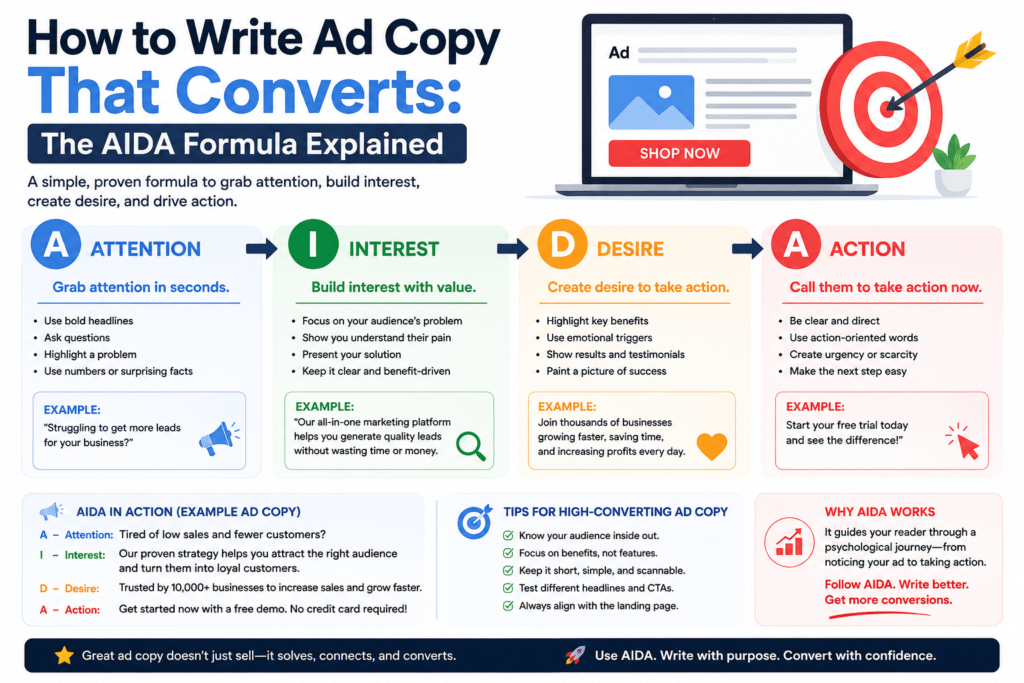
What is the AIDA Formula?
AIDA stands for four sequential stages of consumer engagement:
Attention (The Hook)
Interest (The Value)
Desire (The Proof)
Action (The CTA)
By guiding your audience step-by-step from curiosity to commitment, you remove friction and make saying “yes” effortless.
Step 1: Attention (Stop the Scroll)
In a crowded feed, you have less than three seconds to make someone stop scrolling. If your opening line is boring, generic, or corporate, your ad is invisible.
The Goal: Grab immediate attention by speaking directly to your target audience’s pain point, goal, or curiosity.
Best Practices:
Use bold statements or thought-provoking questions.
Call out your audience directly (e.g., “Attention Kalyan small business owners…”).
Highlight a glaring problem they experience daily.
Example: “Still wasting your monthly ad budget on clicks that never convert into actual leads?”
Step 2: Interest (Keep Them Reading)
Once you’ve stopped the scroll, you need to hold their focus. This is where you explain why they should care about what you are saying. Avoid jumping straight into product features; instead, focus on relevance and empathy.
The Goal: Deepen engagement by delivering informative, relatable context that validates their struggle.
Best Practices:
Keep paragraphs short and punchy.
Introduce a shift in perspective or a smarter way of doing things.
Elaborate briefly on the cost of inaction.
Example: “Most digital campaigns fail not because the platform doesn’t work, but because the messaging misses the mark. Without a proven framework to capture buyer intent, your traffic bounces before they even see your offer.”
Step 3: Desire (Build Trust and Urgency)
People don’t buy products or services; they buy the better version of themselves that your product provides. In this phase, you transform interest into intense want by presenting solutions, benefits, and proof.
The Goal: Make your offer irresistible by combining emotional appeal with logical reassurance.
Best Practices:
Pivot from features to tangible benefits (what’s in it for them?).
Incorporate social proof, guarantees, or specific metrics.
Showcase how your solution transforms their current reality.
Example: “Our framework helps local brands cut customer acquisition costs by up to 40% while doubling inbound inquiries. Backed by 10+ years of performance management experience, it’s designed to deliver predictable, measurable ROI.”
Step 4: Action (Tell Them Exactly What to Do)
Never leave your audience guessing what the next step is. If you want them to book a consultation, download a guide, or buy a product, spell it out clearly and make it frictionless.
The Goal: Prompt an immediate, low-friction response with a compelling Call to Action (CTA).
Best Practices:
Use strong, action-oriented verbs (e.g., Claim, Book, Get, Start).
Add a touch of urgency or scarcity when appropriate.
Ensure the link or button matches the promise of the ad.
Example: “Ready to transform your ad performance? Click below to book your free strategy audit today!”