If you open up your social media dashboard right now, you’ll likely be greeted by a dizzying array of data: impressions, reach, profile views, likes, shares, and video completion rates. It is easy to fall into the trap of tracking everything, leading to a state of data overload where you are tracking a lot, but learning very little.
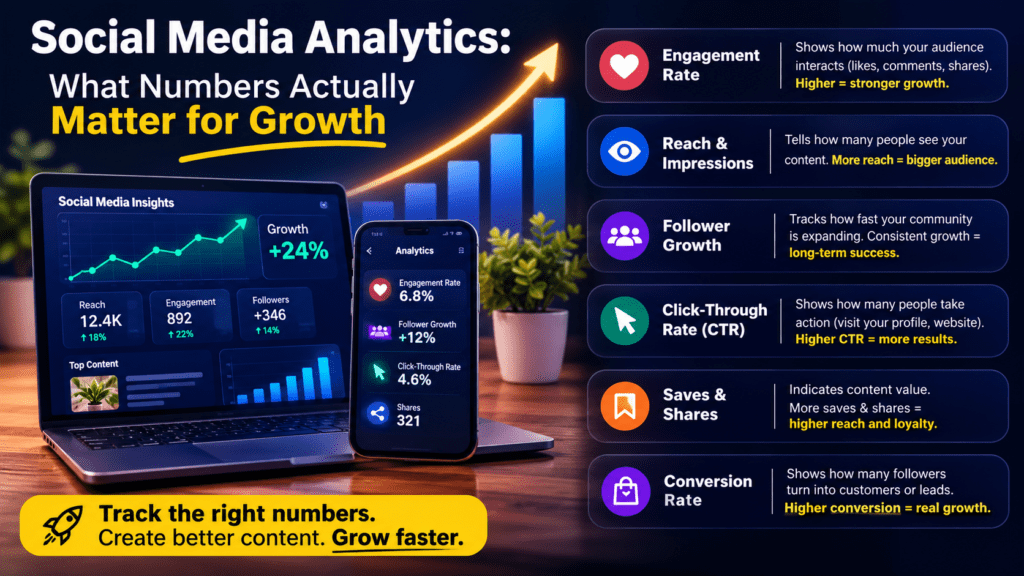
1. Engagement Rate (Quality Over Quantity)
A massive follower count means very little if nobody cares what you post. That’s why Engagement Rate—the percentage of people who interacted with your content (likes, comments, saves, and shares) relative to your total reach or followers—is a crucial indicator.
Why it matters: It proves that your content isn’t just being scrolled past; it’s actively resonating.
The Growth Indicator: Saves and shares are gold-standard metrics here. A “like” is passive, but a “save” means the content was valuable enough to revisit, and a “share” means your audience is willing to endorse your brand to their own networks.
When the ultimate goal is real, sustainable business growth, vanity metrics can trick you into thinking you’re succeeding while your bottom line stays flat. So, which numbers actually move the needle? Let’s cut through the noise and look at the key performance indicators (KPIs) that truly matter.
2. Conversion Rate & Link Clicks (The Bottom-Line Metrics)
Social media shouldn’t just exist in a vacuum; it should drive action. If your goal is to grow your business, you need to track how effectively your social presence funnels people to your website, landing pages, or store.
Why it matters: Click-Through Rate (CTR) and social conversions tell you how many people liked your content enough to take the next step.
The Growth Indicator: Keep a close eye on website sessions originating from social channels and your specific conversion rate (sign-ups, purchases, or leads). This bridges the gap between social media buzz and actual revenue.
3. Audience Growth Rate (Tracking Momentum)
Instead of looking at your total follower count in isolation (a classic vanity metric), measure your Audience Growth Rate—the speed at which you are gaining new followers over a specific period.
Why it matters: A steady, compounding growth rate indicates that your brand message is consistently finding and attracting new members of your target demographic.
The Growth Indicator: Rather than aiming for arbitrary milestones, track your percentage growth week-over-week or month-over-month. If your growth rate is accelerating, your current content strategy is working.
4. Reach vs. Impressions (Measuring Visibility)
It helps to understand the difference between these two visibility metrics:
Reach: The number of unique users who saw your post.
Impressions: The total number of times your content was displayed (even if the same person saw it multiple times).
Why it matters: High reach means your content is breaking out of your existing bubble and landing on new feeds (often via algorithms, hashtags, or shares). High impressions relative to reach mean people are coming back to view your content more than once, signaling deep interest.
Turning Data into Action
Data is only as valuable as the decisions you make with it. To shift from passive tracking to active growth:
Align metrics with goals: If your goal is brand awareness, focus on reach and shares. If your goal is sales, focus on CTR and conversions.
Audit monthly: Look at your top three performing posts each month. Do they share a common format, topic, or call-to-action? Double down on what the data proves your audience loves.