Master Class: How to Create a Social Media Strategy from Scratch
Creating a social media strategy from scratch requires a structured, step-by-step approach that aligns your digital presence with measurable business outcomes. The process begins with establishing clear SMART goals—such as increasing brand awareness, generating qualified leads, or driving website traffic—and defining your target audience profiles to ensure your content resonates deeply. Next, conduct a competitive audit to identify market gaps, and select 2–3 core channels where your ideal audience is most active rather than spreading resources too thin. Once your platforms are optimized with keyword-rich bios and consistent branding, establish 3–5 content pillars—such as educational tutorials, behind-the-scenes stories, and promotional offers—guided by the 80/20 rule to maintain a healthy balance between value and selling. Finally, streamline production using a content calendar to batch-schedule posts, actively engage with your community in real time, and systematically review performance metrics monthly to refine your tactics.
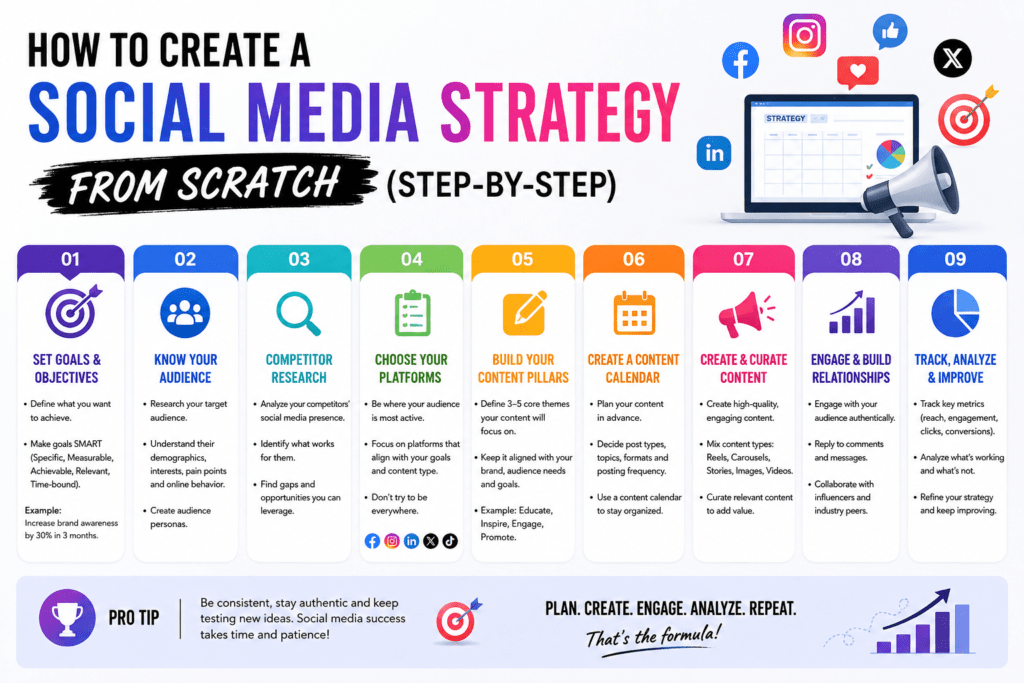
Posting consistently on social media without a clear plan is like driving blindfolded: you spend a lot of energy, but you rarely reach your intended destination.
Whether launching a new business or revamping an existing brand online, building a social media strategy from scratch transforms social channels from noisy execution pits into steady drivers of growth.
Phase 1: Foundation & Alignment
Step 1: Set SMART Goals Tied to Business Outcomes
Your social media objectives should directly support broader business goals. Instead of pursuing vague vanity metrics (like total follower counts), define concrete, measurable targets using the SMART framework.
Specific: Focus on a precise metric (e.g., increase website referral traffic).
Measurable: Attach numbers to the goal (e.g., +25% traffic increase).
Achievable: Ensure the target is realistic based on current resources.
Relevant: Connect the metric to business revenue, leads, or brand reach.
Time-bound: Set a strict deadline (e.g., within Q3).
Example SMART Goal: “Drive 500 qualified website visits per month from LinkedIn by publishing two long-form article breakdowns per week through the end of Q3.”
Step 2: Define Your Ideal Audience & Buyer Personas
Speaking to everyone means speaking to no one. Build detailed audience profiles before drafting your first post.
To build an actionable persona, answer these key questions:
Demographics: Age, location, job title, income level.
Psychographics: Values, interests, key media consumption habits.
Pain Points: What core problem are they trying to solve?
Social Behavior: Where do they actively seek recommendations vs. passive entertainment?
| Funnel Stage | Core Audience Focus | Key Metrics to Track |
| Top of Funnel (Awareness) | Unaware browsers seeking value or entertainment | Impressions, Reach, Shares |
| Middle of Funnel (Consideration) | Problem-aware users evaluating options | Comments, Saves, Link Clicks |
| Bottom of Funnel (Conversion) | Solution-aware leads ready to decide | Conversion Rate, Sign-ups, Sales |
Phase 2: Intelligence & Setup
Identify 3–5 direct competitors and analyze their social channels. Look at their posting frequency, top-performing formats, engagement rates, and how they handle community discussions. Identify gaps they are failing to address so you can position your content around those unmet needs.
You do not need to be active on every social platform. Pick 1–2 primary channels where your audience spends the most time and where your content capabilities align best:
LinkedIn: Best for B2B, thought leadership, and professional networking.
Instagram/TikTok: Ideal for visual storytelling, short-form video, and product discovery.
YouTube: Powerful for long-term evergreen search value and detailed tutorials.
X (Twitter): Great for real-time engagement, news updates, and community commentary.
Social channels double as search engines. Ensure every active profile includes:
A high-resolution profile image/logo and cohesive banner visual.
A clear, keyword-rich bio explaining exactly who you serve and what value you provide.
A single, trackable primary CTA link (or link tree) pointing to your core conversion page.
Phase 3: Creation & Execution
Establish Content Pillars
Content pillars are 3–5 recurring core themes that define your posting strategy. They keep content organized while preventing burnout.
┌─────────────────────────────────────────────────────────────┐
│                       CONTENT PILLARS                       │
├───────────────┬───────────────┬───────────────┬─────────────┤
│  Educational  │  Inspirational│ Behind-the-   │ Promotional │
│  & How-Tos    │  & Stories    │ Scenes        │ & Product   │
├───────────────┼───────────────┼───────────────┼─────────────┤
│ Solves common │ Builds emotional│ Builds trust │ Drives direct│
│ pain points   │ connection    │ & authenticity│ conversions │
└───────────────┴───────────────┴───────────────┴─────────────┘
A reliable mix follow the 80/20 Rule: 80% of content should inform, entertain, or educate, while 20% directly promotes your products or services.
Build a Content Calendar Workflow
Consistency requires planning ahead. Set up a content calendar to organize asset production and scheduling:
Batch Creation: Schedule dedicated days to record videos, design graphic assets, and write copy.
Repurpose Efficiently: Turn one long-form asset (like a long blog post or podcast) into 3 carousel posts, 2 short-form videos, and several text updates.
Schedule in Advance: Use tools like Buffer, Hootsuite, or native platform schedulers to automate publishing.
Phase 4: Analysis & Optimization
Creating content is only half the battle. A strategy stays effective only through regular performance reviews
Monitor comments, DMs, and mentions. Respond quickly to foster high-intent relationships and feed engagement signals to platform algorithms.
Review quantitative performance data. Analyze which post formats (e.g., short video vs. static carousels) generated the highest saves, shares, and website traffic.
Compare overall progress against your original SMART goals. Double down on top-performing content categories and sunset underperforming themes or channels.
Conclusion:
Building an effective social media strategy is not a static, one-time task, but an evolving blueprint. By shifting from random posting to a data-driven, step-by-step framework, you turn social platforms into predictable engines for long-term brand equity, customer trust, and business growth.