India’s digital advertising ecosystem is growing at an unprecedented rate. As businesses shift budgets toward Meta’s advertising network, one core question dominates digital strategy meetings: Where should you spend your marketing rupees for maximum Return on Investment (ROI)—Facebook or Instagram?
While both platforms run via Meta Ads Manager and share similar backend targeting tools, their user demographics, cost structures, engagement patterns, and conversion behaviors in India are fundamentally different.
Here is an in-depth breakdown to help you decide which platform delivers higher ROI for your brand.
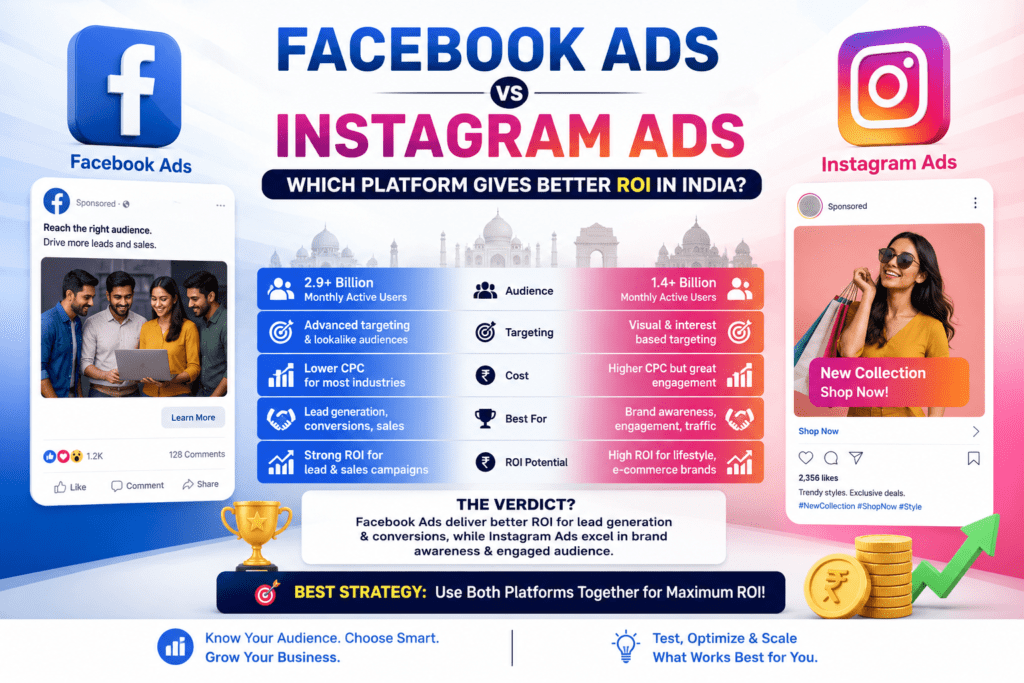
1. Demographic & Reach Comparison in India
Understanding where your audience spends their time is step one in maximizing ROI.
Facebook in India (310+ Million Users):
Demographics: Skews slightly older (ages 25–55+), balanced across gender and geography (Tier 1, Tier 2, Tier 3 cities, and semi-rural regions).
Behavior: Users consume community updates, news, long-form posts, local groups, and family content.
ROI Advantage: Unmatched mass reach across older decision-makers and broad consumer segments with steady disposable income.
Instagram in India (350+ Million Users):
Demographics: Dominated by Gen Z and Millennials (ages 18–34) concentrated heavily in urban, semi-urban, and metro areas.
Behavior: Highly visual, trend-driven, heavily focused on short-form video content (Reels), lifestyle aesthetics, and influencer recommendations.
ROI Advantage: High engagement rates, strong aspirational appeal, and rapid impulse purchase decisions.
2. Ad Cost Benchmarks: CPM, CPC, and Conversions
In performance marketing, initial cost metrics directly determine your return on ad spend (ROAS).
| Metric / Benchmark | Facebook Ads (India) | Instagram Ads (India) | Key Takeaway |
| Average CPM (Cost per 1,000 Impressions) | ₹40 – ₹120 | ₹90 – ₹220 | Facebook is cheaper for generating broad top-of-funnel reach. |
| Average CPC (Cost per Click) | ₹2.50 – ₹10.00 | ₹6.00 – ₹22.00 | Facebook yields cheaper clicks, ideal for high-traffic campaigns. |
| Average CTR (Click-Through Rate) | 0.8% – 1.6% | 1.2% – 2.8% | Instagram drives higher CTRs due to immersive visual ad formats. |
| eCommerce Conversion Rate | 1.5% – 2.8% | 2.2% – 4.5% | Instagram converts visual/D2C traffic at a higher rate. |
Cost vs. Value Insight: Facebook gives you cheaper traffic and impressions, but Instagram often delivers higher-intent users, leading to better overall conversion rates despite higher initial unit costs.
3. Industry Sector Breakdown: Where Each Platform Wins
The definition of “Good ROI” varies by business model. Here is how both platforms perform across major Indian industries:
A. Direct-to-Consumer (D2C), Fashion, Beauty & Lifestyle
Winner: Instagram Ads
Why: Visual storytelling is critical. High-quality Reels showcasing unboxings, influencer collaborations, and aesthetic lifestyle videos generate impulse purchases. Indian D2C brands frequently report 3.5x to 6x ROAS on Instagram.
B. B2B, Real Estate, Education & Financial Services
Winner: Facebook Ads
Why: High-ticket decisions require detailed information, trust building, and direct communication. Facebook users in the 30–55 age bracket are far more responsive to long-form copy, lead collection forms, and direct link ads.
C. Regional & Mass Market Consumer Brands (Tier 2/3 Focus)
Winner: Facebook Ads
Why: Facebook’s penetration in Tier 2, Tier 3, and vernacular language markets gives brands affordable customer acquisition costs (CAC) when targeting non-metro populations.
4. Format ROI: Reels vs. Stories vs. Click-to-WhatsApp
Selecting the right ad format within Meta can dramatically increase your return:
Instagram Reels Ads: Currently the highest-performing organic and paid placement in India. Short 15–30 second video ads with strong hooks deliver the lowest cost per acquisition (CPA) for consumer brands.
Click-to-WhatsApp Ads (Facebook & Instagram): Highly effective in India. Instead of sending traffic to a website landing page, driving users directly to a automated WhatsApp Business conversation increases lead response rates by up to 35% – 40%.
5. Final Verdict: Which Platform Gives Better ROI?
The winner depends entirely on your campaign goal and industry vertical:
Choose Facebook Ads if:
Your goal is high-volume lead generation (B2B, Real Estate, Higher Education, Loans/Insurance).
You want maximum impression reach at the lowest possible cost across Tier 1 to Tier 3 India.
Your target audience is 35+ years old.
Choose Instagram Ads if:
You run a D2C, Fashion, Beauty, Gadget, or Lifestyle brand.
Your target audience is Gen Z or Millennials in urban/metro India.
You have high-quality video creative assets (Reels) and influencer content
Pro-Tip for Marketers: The Hybrid Strategy
For maximum ROI, performance agencies in India use a hybrid Meta strategy:
Top of Funnel (Prospecting): Use Facebook & Instagram Reels with broad targeting for cost-effective reach and audience discovery.
Bottom of Funnel (Retargeting): Retarget warm visitors on Instagram Stories/Reels with limited-time discount codes and social proof to drive final sales conversions.
Pro-Tip for Marketers: The Hybrid Strategy
For maximum ROI, performance agencies in India use a hybrid Meta strategy:
Top of Funnel (Prospecting): Use Facebook & Instagram Reels with broad targeting for cost-effective reach and audience discovery.
Bottom of Funnel (Retargeting): Retarget warm visitors on Instagram Stories/Reels with limited-time discount codes and social proof to drive final sales conversions.
Determining whether Facebook or Instagram yields a better ROI in India ultimately comes down to your campaign objective and industry vertical. Recent 2026 data shows that Facebook continues to dominate in cost efficiency—offering significantly lower Cost Per Click (CPC) and Cost Per Mille (CPM)—making it the champion for high-volume lead generation, B2B services, and campaigns aimed at older demographics (ages 25+). On the other hand, Instagram demands a higher premium per click but delivers exceptional conversion rates and superior Return on Ad Spend (ROAS) for visual-first Direct-to-Consumer (D2C), fashion, and lifestyle brands targeting urban Gen Z and Millennials, particularly through high-engaging Reels. In conclusion, the days of treating these platforms as isolated silos are over; the highest ROI in the Indian market is achieved through a unified Meta strategy that leverages Facebook’s cheap inventory for broad, top-of-funnel prospecting and Instagram’s immersive formats for high-intent, bottom-of-funnel retargeting.