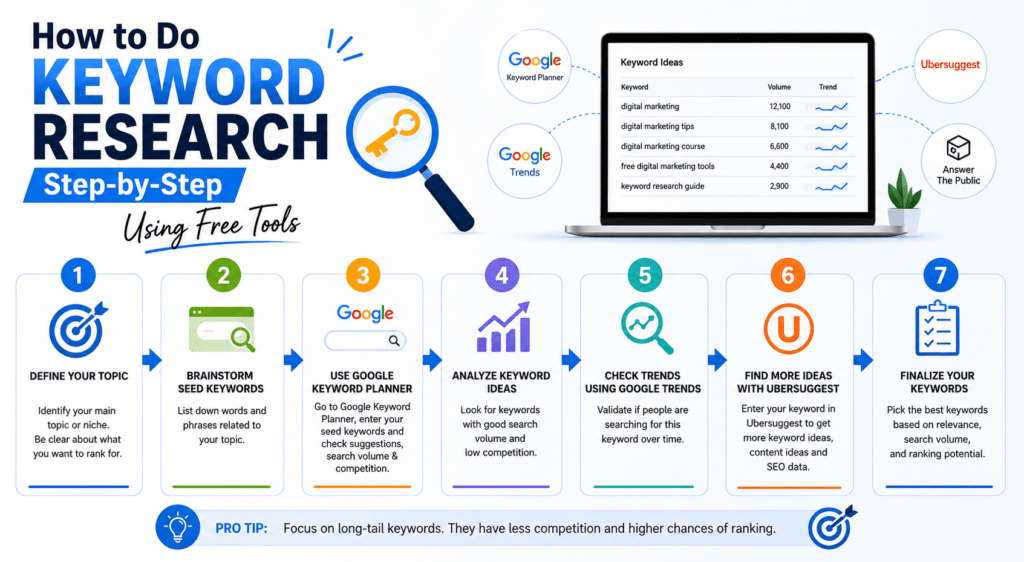
Finding the right keywords is often treated like a high-stakes guessing game—or worse, an expensive one. Many creators assume you need a $100/month tool subscription before you can write a single rankable article.
The truth? You can build a complete, high-traffic SEO keyword strategy using 100% free resources.
Keyword research isn’t about collecting massive lists of terms; it’s about uncovering the exact phrases your audience types into Google when looking for answers, and finding the sweet spot where search demand meets realistic ranking potential.
Here is a simple, 6-step blueprint to master keyword research without spending a single dollar.
The Free Keyword Research Toolkit
Before diving into the process, bookmark these core free resources:
Google Search (Autocomplete & People Also Ask): Uncovers real user search behaviors and related questions directly from Google’s database.
Google Keyword Planner: Free with any Google Ads account, offering direct search volume estimates.
Google Trends: Tracks whether interest in a topic is rising or fading over time.
Ahrefs Free Keyword Generator: Instantly surfaces up to 100 related keyword suggestions and basic difficulty estimates.
AnswerThePublic: Maps out question-based queries (who, what, where, why, how) around your core topic.
6 Steps to Free Keyword Research
Step 1: Identify Your Seed Keywords
Start by defining 3–5 core topics central to your niche. Ask yourself: “What broad topics does my site cover, and what primary problems do I solve?”
If you run a home coffee blog, your seed keywords might be:
Espresso machine
French press
Cold brew
Keep seeds short (1–2 words). You won’t target these broad terms directly; you will use them to discover specific, low-competition opportunities.
Step 2: Expand Seeds with Free Suggestion Tools
Take your seed keywords and generate dozens of variations using these free methods:
Google Autocomplete: Type your seed into Google (e.g.,
"french press ") and let search predictions suggest long-tail variations. Add letters alphabetically ("french press a","french press b") to uncover niche variations.People Also Ask (PAA): Search your seed term on Google and inspect the question dropdowns in the search results. Clicking one question reveals 2–3 more related questions.
Ahrefs Free Keyword Generator: Paste your seed to immediately extract 20 top phrases and 20 question-based keywords.
Step 3: Analyze Search Intent
Before targeting a keyword, you must understand why the user is searching for it. Creating a 3,000-word blog post for a query where users just want a quick calculator will hurt your bounce rate.
Categorize terms into the four primary intent buckets:
Informational: Seeking answers (e.g., “how to clean a french press”) $\rightarrow$ Write a step-by-step guide.
Commercial: Comparing options (e.g., “best french press under $50”) $\rightarrow$ Write a round-up product review.
Transactional: Ready to buy (e.g., “buy Bodum french press replacement glass”) $\rightarrow$ Direct to a store page.
Navigational: Seeking a specific brand (e.g., “AeroPress official site”) $\rightarrow$ Avoid targeting unless it’s your brand.
Step 4: Check Search Volume & Keyword Feasibility
Filter your expanded list by estimated search volume and ranking difficulty.
Plug your list into Google Keyword Planner or the Ahrefs Free Tool to get estimated monthly search volumes.
Search your target keyword in an Incognito Google window and examine the top 5 results:
Are the top results massive authority domains (e.g., Wikipedia, Forbes, Wirecutter)? If so, ranking will be tough for a new site.
Are there forum posts (Reddit, Quora) or smaller niche blogs ranking near the top? That’s a signal of low competition and high ranking potential.
Step 5: Prioritize Long-Tail Keywords
If your site is new, skip high-volume “head terms” (like “coffee beans”). Instead, target long-tail keywords—phrases containing 3+ words that express a specific intent.
Head Term: “espresso machine” (High competition, vague intent)
Long-Tail Target: “how to unblock a breville espresso steam wand” (Low competition, clear intent, fast ranking potential)
Long-tail keywords usually have lower search volume (e.g., 50–500 monthly searches), but visitors convert at a much higher rate because your content answers their exact question.
Step 6: Map Keywords to Your Content Plan
Organize your final list into a spreadsheet:
Group related terms under a single Primary Keyword (the core topic of your article).
Select 2–4 Secondary Keywords (synonyms and subtopic questions to include in your H2/H3 subheadings).
Rule of Thumb: Target one primary keyword per page to avoid keyword cannibalization ( competing against your own articles in Google).